Praxis: A Writing Center Journal • Vol. 23, No. 4 (2026)
An Interim Period of Clinics, early 1940s–late 1960s
Don Moore
Western Connecticut State University
domore.drm@gmail.com
Abstract
This article reexamines the Clinical Period of writing center history (early 1940s–late 1960s) through the lens of Cultural-Historical Activity Theory (CHAT), arguing that the emergence of the writing clinic represented not merely a historical detour but a productive contradiction in the development of modern writing centers. Building on earlier laboratory models, clinicians introduced the rhetoric of diagnosis, remediation, treatment, and tutoring in an effort to modernize writing instruction. While these innovations sought to address concerns about student writing, they simultaneously displaced the collaborative, student-centered practices that had characterized the laboratory tradition, producing tensions between remediation and dialogue, prescription and participation. Drawing on historical scholarship, College Composition and Communication Workshop Reports, and contemporary activity theory, this study traces how these contradictions ultimately contributed to the reassertion of laboratory teaching as the more sustainable pedagogical model. The analysis also demonstrates how the Workshop Reports functioned as mediating artifacts that helped practitioners critically reflect upon and reshape writing center practice while positioning the laboratory as a site for teacher development as well as student learning. Finally, the article connects this history to contemporary writing center scholarship by arguing that rhetorical choices continue to shape professional identity, labor, and institutional status. Understanding the Clinical Period, therefore, provides historical insight into how writing center practitioners can intentionally employ language and organizational practices that promote collaboration, professionalization, and more equitable writing center futures.
Keywords: writing center history; Cultural-Historical Activity Theory (CHAT); writing laboratories; writing clinics; writing center activism
Introduction
In her 2017 Praxis article, Liliana M. Naydan argues that “writing center practitioners, by virtue of their attention to language, are well positioned to reconstitute their identities as academic activists” (29). This insight invites us to consider how activist rhetoric, or at least a form of it, may contribute to the development of sustainable labor practices in the writing center. Emboldened with the power to effect change within the university as well as beyond it, writing center practitioners may begin using strategic rhetorical choices as a sort of rhetorical activism that unconditionally promote equitable reforms in our spaces, thereby modelling how such action may look elsewhere. With the resurgence of authoritarianism in the United States, this work may further enable writing center practitioners to commit to the ongoing work of social justice in the writing center. At this juncture in American history, the rhetorical choices writing centers employ may model a way forward for the professionalization of writing center practitioners as we aim to challenge inequitable labor practices and address injustices against the marginalized populations of students we serve.
Yet writing centers have confronted similar questions before. Around 1940, during the Interim Period of Clinics, a mid-twentieth-century phase of composition instruction in which clinical writing support models emerged alongside and in tension with laboratory-based pedagogy, began to counter the progressive laboratory experiments of the earlier Formative Period (1887–1940). During the Clinical Period, approaches and the specific language used by clinicians redirected the laboratory movement in a drastically new direction from that established over the previous fifty years. While earlier laboratories emphasized collaborative, highly individualized work between teachers and students, the Clinic increasingly adopted the rhetoric of “remediation,” “diagnosis,” “treatment,” and “tutorial.” These rhetorical choices disrupted the Laboratory Movement’s collaborative ethos and introduced systems of stratification and categorization that positioned student writers as deficient subjects in need of correction.
Certainly, the aim of the Clinic was to direct students toward self-correction, but the work in a clinic relied on impersonal feedback from “counselors” who analyzed students’ writing. Ultimately, this mirrors what Nancy Grimm outlines as a closed system in “Retheorizing Writing Center Work,” wherein such systems “create structures that lead to stratification, disconnectedness, dogmatism, narcissism, marginality, factionalism, and imperialism” (91). In these systems, instruction becomes prescriptive rather than collaborative, and students encounter writing center work primarily through cycles of error, correction, and explanation.
Through the lens of third-generation activity theorist Yrjö Engeström, however, these contradictions may also reveal moments of institutional transformation. Engeström argues that when “an activity system adopts a new element from outside . . . it often leads to an aggravated secondary contradiction” that generates “disturbances and conflicts but also innovative attempts to change the activity” (“Expansive Learning at Work” 137). This phenomenon occurs during the Clinical Period as practitioners attempt to modernize the laboratory through systems of remediation. Yet the contradictions introduced by the Clinic ultimately compel the system to evaluate and correct itself.
One important site of this corrective work emerges in the circulation of the “Workshop” reports from the Conference on College Composition and Communication beginning in 1950. These reports repeatedly expose the contradictions between the collaborative Laboratory model and the more rigid Clinic model. Operating as tools for practitioner reflection and assessment, the reports enabled teachers to evaluate, revise, and improve their laboratories. In this sense, the reports function as early models for the kind of reflective and equitable institutional work writing centers continue to pursue today.
Thus, this article offers a historiographic examination of the Clinical Period through the lens of Cultural-Historical Activity Theory (CHAT). By tracing how practitioners and scholars constructed distinctions between the Laboratory and Clinic models, I examine how the rhetorical choices of the Clinical Period contributed to systems of stratification that continue to shape writing center discourse and labor practices. I also analyze the Conference on College Composition and Communication’s Workshop reports as sites of institutional reflection and revision, highlighting the field’s ongoing efforts to redefine its pedagogical identity. Ultimately, this historiographic approach returns to Liliana Naydan’s call for activist writing center work by considering what contemporary practitioners may learn from the contradictions of the Clinical Period as they pursue more equitable and sustainable futures for writing center practices.
Cultural-Historical Activity Theory (CHAT)
Cultural-Historical Activity Theory (CHAT) provides the methodological framework for this study. More specifically, I draw on Yrjö Engeström’s model of interconnected activity systems to examine the historical development of writing center practices. From this perspective, writing center work evolves through ongoing processes of reflection, disagreement, adaptation, and institutional response. CHAT is particularly useful for this project because it frames writing center history not as a linear sequence of pedagogical stages, but as a dynamic process shaped by contradictions that generate institutional and rhetorical transformation over time. Across generations, practitioners circulate strategies, revise inherited practices, and create new possibilities for writing center work.
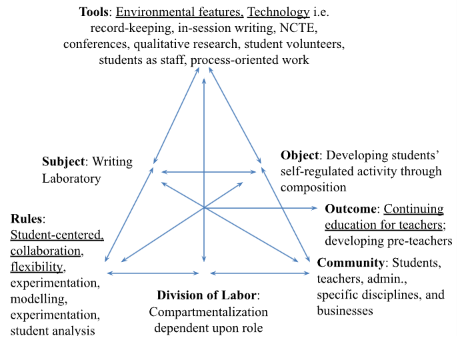
Figure 1. The developing Writing Laboratory, c. 1940.
Figure 1 illustrates the theoretical and environmental structure of the Writing Laboratory at the end of the Formative Period (1940), closely resembling modern writing center activity. Over the previous 60 years, mediating artifacts such as tables, chairs, technology, resource libraries, student files, and empirical research shaped this system. The NCTE also contributed by facilitating information sharing. A student-centered approach and collaboration serve as system rules while the developing teacher remains part of the outcome with teachers’ flexibility also seen as rules or tools within the system. Laboratories aim to foster self-sufficient students in flexible environments with student workers and pre-teacher training further shaping the system. By the end of the Formative Period, the developing teacher becomes an outcome of this evolving activity system.
Engeström’s CHAT framework reveals how communities develop and recreate themselves over time. He explains: “Goal-directed individual and group actions, as well as automatic operations, are relatively independent but subordinate units of analysis, eventually understandable only when interpreted against the background of entire activity systems” (“Expansive Learning” 136). When CHAT is applied across generations, contradictions emerge that prompt new generations to revise previous practices. This dynamic becomes evident in the Clinical Period as I examine scholarship from the 1940s–1960s to trace tensions between Laboratory and Clinical pedagogies. In doing so, I offer modern writing center practitioners an interpretive history of the Clinical Period’s impact on the Laboratory Movement, one that anticipates practitioners “poised to engage in activist rhetoric and live lives as academic activists” (Naydan 29). Naydan’s call for practitioners to recognize their rhetorical role in shaping institutional futures revisits these historiographic contradictions and allows contemporary writing center practitioners to reconsider which rhetorical and institutional practices continue to reproduce exclusionary or inequitable conditions in present-day centers.
The Stratification of a Generation
Alvin Fountain’s ruminations in his 1940 College English article, “The Problem of the Poorly Prepared Student” demonstrate an attitude that may have helped usher in a new formula for the Laboratory. He argues that “we have inevitably, perhaps unconsciously, lowered our secondary-school standards to those of the average, rather than to those of the superior student” (318). Here, it appears Fountain offers a critique of what he believes are failed policies, and in doing so, suggests the universal right of upward mobility has limits, thus, prefacing the stratification and marginalization of students. However, such a practice contradicts the collaborative model of the Laboratory, and with this methodology at the forefront of the movement, the stage is set for this generation’s clinical experiments. In this way, the rhetoric of remediation did not merely describe struggling students; it actively reshaped institutional relationships between students, teachers, and writing instruction.
In fact, Fountain’s advancement of an exclusionary environment appears cloaked in resentment: “A generation ago only those with considerable energy, initiative, and vision finished high school at all, and many of those never attended college. Now . . . essentially the entire adolescent population is in high school, many of them for no particular reason” (318). This critique reaches into the practicality of the most progressive aspects of the previous generation’s trending Laboratory method and seems to directly mock Deweyan concepts of education arguing that “in our efforts to ‘prepare the student for the community in which he is to live,’ we have extended elective privileges to students too young to exercise them, and from homes not qualified to advise concerning them . . .” (Fountain 319). This tone of separation permeates Fountain’s argument and sets a trajectory for the remediation experiment of the Clinic. Fountain’s stringent ideology toward rejuvenating exceptionality in the academy not only creates pedagogical contradictions with the Laboratory movement, but the external, territorial contradictions exacerbate the problems of breaking down barriers of class and race during one of our most tumultuous periods in the advancement of equality.
During the Clinical Period, it becomes clear how the administration of Fountain’s (and others’) new rhetorical choices represents Engeström’s notion that “new element[s] . . . generate disturbances and conflicts” (“Expansive Learning at Work” 137). With Fountain’s analysis of schools that provide “remedial” education, Fountain begins the stratification of students first by classifying the schools that provide specific solutions, or a “Remedy”, to the issue of poor student writing, which he describes as “The Disease.” Specifically, schools that offer no program for the poorly prepared student get categorized as a “Remedy: No Official Treatment” institution. Those schools that offer extra work fall under the category “Remedy: Extra Work without Extra Credit,” or “Remedy: Noncredit, Sub-Freshman Courses.”
Fountain’s rhetorical choices here categorize schools and simultaneously stigmatize students as he engages in the stratification of a generation. He claims that students have a “disease” and suggests schools offer “remedies”, “treatments”, and “diagnoses.” Revisiting the persistence of this language in contemporary writing center discourse demonstrates how rhetorical choices continue to shape institutional attitudes toward student writers and writing support. With “diagnostics” commonly used today, Naydan’s claim that writing centers are constituted through rhetorical choices that carry institutional consequences is firmly reinforced. Moreover, the use of this kind of language directly opposes earlier Deweyan concepts of democratic educational philosophies, for when “a society to which stratification into separate classes would be fatal, [we] must see to it that intellectual opportunities are accessible to all on equable and easy terms” (Dewey 87-88).
Further, in “A Writing Clinic at Iowa State College” (1943), Duncan Mallam intensifies the rhetorical dilemma of the Clinical Period. The report extends the Lab/Clinic tension through the familiar apparatus of diagnostics, prescriptions, and remediation, reinforcing systems of student categorization. Although the Laboratory tradition retained features such as a large instructional space with desks, reference books, and an attendant, the Iowa State Writing Clinic instead redirects self-regulated student activity into a regimented, lecture-based model.
Students begin with a “diagnostic” essay exam—“a test consisting of a 500-word impromptu paper, written within a period of two hours” (“A Writing Clinic” 52)—and those marked by “defects” have their writing “meticulously analyzed” and their “merits and defects… carefully explained” (52). This emphasis on “explaining” reduces instruction to lecture, aligning the Clinic with Freire’s banking model and limiting the collaborative exchange central to equitable pedagogies. In fact, neglecting earlier efforts to develop collaboration between students and teachers in Laboratory settings, Mallam makes it clear that collaboration is rare: “It is understood that no students will be spoon-fed in the clinic, nor will they, except in rare instances, be tutored” (“A Writing Clinic” 52). Here, the opposition between being “spoon-fed” and engaging in collaboration marks a dramatic shift away from the sociable and flexible environments cultivated during the Formative Period, where students developed writing practices through self-regulated interaction. Contemporary writing center scholars continue to identify such collaborative exchange as central to equitable learning practices. For example, Beth Godbee, Moira Ozias, and Jasmine Kar Tang argue that writing center practitioners must examine how “the embodied acts of our practice facilitate or frustrate learning; consolidate or share power; and open or close possibilities for learning, change, and revision” (63–64). In other words, collaborative writing center environments reinforce the reciprocal and socially mediated practices necessary for transfer. The Clinic, however, minimizes these opportunities, as students do not write collaboratively within the instructional space and therefore lack reinforcement practices useful for transfer.
Such practice is also articulated by W. G. Johnson in his 1945 article reporting on the writing clinic at the University of Illinois. In “A Report on the University of Illinois Experimental Writing Clinic” Johnson demonstrates how the clinic continues to move away from a collaborative model, claiming, “the clinic does not supervise writing or provide tutoring” (9). With collaboration and modelling largely absent, Johnson’s methodology generates further contradictions between the new and old. The days of collaboration in the laboratory are not gone, as Clinics and Laboratories exist simultaneously. However, with the Clinic, a new ideology challenges progressive work beginning after Genung’s call for reform to Francis Appel’s conceptualization of collaborative, personal writing [1], and it sits in direct opposition to current twenty-first century practices. In fact, with Mallam and Johnson, “tutor” and “tutoring” become part of the lexicon of the clinic.
Notably, when Appel meets with students, he uses terms like “meeting”, “work”, and “conference”, yet the progression of Laboratory practices appears overlooked by Clinicians as they continually move further away from the cooperative environment espoused by the previous Laboratory movement. In this setting, discerning how students gain self-sufficiency without direction in the clinic is a concern. Counselors do not engage students as they write, nor do they monitor students’ progress through collaborative efforts; therefore, rules remain abstract. Instead, “counselors” analyze student writing, “suggest remedies,” and then they send students to “remedial agencies” (Johnson 11). Through this method, adaptability relies largely on the individual without the aid of sociality “as determined through problem solving under adult guidance or in collaboration with more capable peers” (Vygotsky 86). Minus the sociality linking abstract problem solving to concrete instruction, students exiting the clinic find themselves further marginalized and isolated. Despite the use of self-regulatory processes, categorization of individual students in the academy seems a necessary evil at institutions throughout the U.S in the early part of the 1940s.
And when the marginalization and categorization of students had not gone far enough, in 1946, J. O. Bailey described a dramatic trend of exclusion. He writes that the University of North Carolina began “to single out all students in advanced courses who wrote poorly” (145). These students earn the “diagnosis” of having a “composition condition” or CC for short meaning students who have the CC must complete work in the “Composition Condition Laboratory.” Such a diagnostic approach automatically stigmatizes students, contradicting the original laboratory model. Once a welcoming, impartial space, the Laboratory is now a hypercritical environment where students feel isolated from the broader university community. At the University of North Carolina, the creation of the “composition condition” further entrenches this stigma, applying the banking method of instruction. This practice exemplifies the dangers of taking Clinical trends too far, as it disintegrates the collaborative nature of the Laboratory model. And while the university calls their program a “Laboratory,” it follows Clinical methods, as discussed by Robert Moore in his clinic vs. laboratory debate.
Enter Robert Moore
Preceding Moore’s defining moment in outlining the laboratory and the clinic, he and his colleague at the University of Illinois, W. G. Johnson, discuss a model of remediation and offer suggestions toward developing courses that will operate as part of a remedial program. With stratification and marginalization of students at the forefront of the collaborative-vacant clinical/remediation experiment, Johnson argues (1945 “A Report”) that “if the Writing Clinic is to have any value, it must have remedial agencies to which it can send the students with problems” (11). As Johnson and Moore work toward building a clinical system of remediation, Johnson proposes creating short courses for grammar and spelling (Rhetoric 0 for non-freshmen), a year course in the elements of English, and a remedial course designed for the upperclassmen (Rhetoric 5).
A discussion of Rhetoric 5 appears in Moore’s 1945 article “The Upperclass Remedial English Course at the University of Illinois.” With his Rhetoric 5 course designed for the upperclass student who writes “a semiliterate gibberish” (Moore “The Upperclass” 5), Moore’s description of the University of Illinois’ program outlines the emerging remedial system. However, Moore’s “gibberish” remark highlights the growing trend of stratification within the clinical approach. While helping students succeed in written English is important, this form of criticism fosters a less welcoming, less flexible faculty. In this environment, courses and Clinics work together, where faculty refer students to “counselors” who explain “rules.” Instead of promoting collaboration, the program creates more division under the guise of progress and efficiency, moving away from the practical spirit of the Formative Period.
Nonetheless, demonstrating the evolution of the Clinic in 1948, Moore describes how the diagnostic gets modified, and a “preliminary interview usually uncovers the principal source of difficulty” (“The University” 9). In his 1948 article “The University of Illinois Writing Clinic”, Moore shares how the Clinic at the University of Illinois has undergone changes since its inception in 1944. While more tests may follow an initial interview, the Clinic has become voluntary for students, and an emphasis on alleviating the development of any stigma appears to take shape: “To allow the student to feel stupid or unwelcome or badgered is fatal to the securing of the voluntary and persistent effort which he must expend if his deficiencies are to be corrected” (Moore “The University” 11). Here, aspects of the original Formative Period Laboratory movement begin to get maneuvered back into the fold. Clinics and Labs begin to coalesce; thus, more crossovers occur between the lab and the clinic.
In 1950, however, Moore recognized contradictions between the Lab and the Clinic and confirmed in his landmark article, “The Writing Clinic and the Writing Laboratory,” that the flexibility once appreciated and encouraged in laboratory instructors has given way to a stringent, clinician’s method of telling students where their deficiencies lie. “Counsellors” no longer adapt to situations, and flexibility suffers in the clinic. Students follow prescribed notions of correction without demonstrations confirming how those “prescriptions” apply to their unique situation; heretofore, typically demonstrated through the Laboratory’s in-session writing efforts.
On the other hand, Moore states: “remedial treatment used in the laboratory varies widely . . . with roving instructors constantly available to answer questions, advise on organizational problems, and check on progress” (“The Writing” 392). Additionally, Moore notes that counsellors do not concern themselves “with the direct supervision of remedial efforts” (390). Conversely, “the [laboratory] instructor makes use of all the teaching devices at his command to clarify the basic principles involved and to stimulate the student to apply them in his own practice” (392). In his article, Moore paints a clear picture of the differences between the Clinic and the Lab. He outlines the characteristics of each program—the regimented Clinic vs. the flexible Lab—making it clear how the two overlap in organization yet retain significant instructional differences.
Moore’s well-documented observations in “The Writing Clinic and the Writing Laboratory” observe that in the Clinic, the “clinicians” are most concerned with “diagnosis and prescription” while the Laboratory “is primarily concerned with the direct and continuing supervision of the remedial efforts of the individual student” (389). For the development of the Laboratory method, Moore’s work establishes the Laboratories’ significance in the academy. He suggests the Clinic operates as part of a system “most satisfactory as a supplement to a wider remedial program . . .” (Moore “The Writing Clinic” 390). Yet noting that the Writing Laboratory may function as the entire remedial program, Moore offers his self-assessment and reflection of his clinical and laboratory work: “the laboratory can be used as the sole remedial agency, if the institution is willing to provide only one” (391). Here, Moore acknowledges the efficiency of the Lab compared to the Clinic but notes that the Clinic lacks the intimacy and collaboration of individualized curricula, revealing an early recognition that collaborative models better support equitable participation than deficit-oriented clinical systems.
Exeunt Moore . . . and the Clinic
Through the implementation of the Clinic, clinicians foment the marginalization and classification of students with less community engagement and collaboration available, and with limited instruction, they put in place a system standing in direct opposition to the Laboratory setting where student engagement flourished. Though the Clinical system of remediation aims to provide supplemental instruction to struggling student writers, the banking method of instruction places direction squarely in the hands of the “counselor” not the student. Thus, it soon becomes clear how this system pales in comparison to the supplemental, collaborative practices found in the extracurricular literary groups and laboratory writing classrooms of the previous generation.
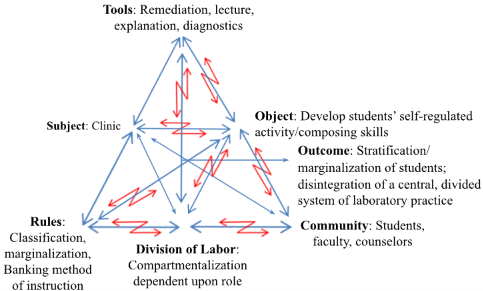
Figure 2. Marginalization and stratification contradictions brought about by Clinical reforms to the Laboratory system.
As illustrated in Figure 2, contradictions found in the Clinic disrupt the system of activity originally found in the earlier Formative Period’s experiments. For example, replacing in-session writing and collaboration, explanation and diagnosis fail in meeting self-regulatory objectives of the system. Instead of following the guiding principles established during the Formative Period such as flexibility and a student-centered approach, the banking method increases confusion through the absence of writing in-session and the natural collaborative reinforcement that follows such instruction. Additionally, while a community of students, faculty, and counselors engage in the clinic through a division of labor, the tools of the labor are unevenly applied among the system’s members. Thus, the stratification and marginalization of students continues through variations of the clinic.
In the clinic, students receive instruction with little guidance and no collaboration with peers or instructors. And while faculty and counselors work well with the lecture and explanation tools, student engagement with the tools does not make possible opportunities for reinforcement from the instructor. Thus, the result creates disturbances between the division of labor, object, and rules of the clinical system, for “if a community of practice wants to encourage learning, it must focus on ways to increase opportunities for participation, and in doing so, it must change itself” (Grimm “Retheorizing” 96). Ultimately, as Figure 2 illustrates, the regressive nature of the system’s move in replacing collaboration with a banking method of instruction makes for a one-way street with the conflation of clinical discourse in a laboratory writing environment tarnishing tools of the trade first established during the Formative Period. In the end, the CCC’s reports will show how the Clinic ultimately functions as a tool in the evolution and gestalt of the Laboratory and Writing Center to follow.
The CCC’s Workshop Reports
After the 1949 Conference on College Composition and Communication meeting, the organization released its first Workshop Report in 1950. The report outlines the types of writing laboratories, their attendees, and their methods of attendance (compulsory or voluntary), offering guidance for practitioners seeking to develop writing labs at their institutions. These discussions establish a central tenet of the Laboratory space: students receive “individual attention” (“Organization and Use of the Writing Laboratory” 31). The first report also fosters collaborative brainstorming among participants, who share laboratory experiments and practices, highlighting Yrjö Engeström’s idea that contradictions can spark innovation. In addition, the reports help practitioners envision how laboratory methods might be adapted to their own institutional contexts, re-emphasizing the student-centered approach associated with the Formative Period. Today, the Workshop Reports reflect Liliana Naydan’s charge that modern-day writing center practitioners can “shape education and professionalism in their most influential and inspiring forms as always already activist enterprises that seek to change the status quo” (35). Naydan therefore identifies the rhetorical and institutional work of writing centers as collaborative and equity-oriented practices. Emerging alongside the stratifying tendencies of the Clinical Period, this work strengthens the Writing Lab movement, and Naydan’s intervention carries the collaborative principles of the 1951 report forward into contemporary writing center discourse.
In the second report of Workshop No. 9, specific attributes of the laboratory space are provided with well-defined attributes of the physical space including the set-up of the space and the technology and materials that can be provided:
The room should be equipped with tables or desks and with shades or blinds which permit complete darkening, and with plenty of blackboard space. The laboratory should have an opaque projector and screen . . . and constant use should be made of such equipment. There should be a reference library of dictionaries, handbooks, usage guides, current periodicals, and other pertinent material (“Organization and Use of a Writing Laboratory” 17)
Describing the physical properties of Laboratory space adheres to other guiding principles including environmental space and technology of the Formative Period where a well-lit room and a space specifically designed for writing activities provides for the work engaged in the Laboratory. Additionally, the 1951 report adds “none of the activity of the laboratory should be fixed or rigid… The writing laboratory should be what the classroom often is not—natural, realistic, and friendly” (18). Opposing rigid forms of instruction, the CCC’s reports offer a counter to the Clinic and a voice for the Laboratory movement. With their descriptions of the teacher who works in the Laboratory, these reports further the guiding principle of a developed and flexible teacher, and they enforce the notion that those who teach in the lab should have a desire for the work and should not be assigned there for expediency or convenience.
Moreover, in her 1950 article, “A Laboratory Method for English,” Ina Marmon provides proof that her Laboratory workspace still operates and uses the original guiding principles developed during the Formative Period, thus offering a model for the content of the CCC’s reports. Reporting on her laboratory classrooms from Stockton College, Marmon demonstrates how her Laboratory reflects the accommodations suggested by the reports when she states “care was taken in the matter of the physical space of the rooms…books, magazines, and audio-visual devices can easily be shifted back and forth [and] …There are comfortable chairs and chrome tables in pastel shades of color” (270). Marmon has carried on the tradition of the environmental guiding principle of providing a comfortable and inviting space for her students that highlights the natural, realistic, and friendly nature of the Laboratory space. Additionally, through her discussion of the students she encounters, the laboratory space, and of the work itself, Marmon expresses her enthusiasm for the work in which she is engrossed.
The professional quality of Marmon’s work is revealed as she argues “the approach, in any case, is that of sincere and friendly helpfulness, coupled with professional techniques proven to be successful through experience” (269-70). By recognizing the usefulness of a developed teacher, Marmon wholly reflects other original guiding principles of the Laboratory: the work is student-centered, collaborative workspace and directed by a developed and flexible teacher. Thus, Marmon demonstrates the reports’ usefulness as tools for other potential Laboratories’ developments.
Highlighting these contradictions, in 1953, the CCC’s reports moved to define the Clinic in “Clinical Aids to Freshman English: The Report of Workshop No. 14.” Outside of recommending the use of technology with nothing pointing specifically to the teaching of writing, the report offers little reporting on instruction offered to students. Listing Harvard films, a tachistoscope and an opaque projector, the report concludes “the recommendation was made that each class assignment should include all three of the channels of communication, rather than just one” (103). The report focuses on staffing the clinic, offering little guidance on instruction and only a vague reference to technology. Suggesting “graduate assistants, the regular instructor, any instructor in the college, or any part-time help” might staff the clinic, they conclude that none “were found to be desirable” (“Clinical Aids” 102). Thus, it appears the college with a Clinic wants the program, but they do not know how to go about staffing it without “a special staff member who should be trained” (102). Similarly, like the lack of specifics in teaching techniques offered, they do not offer any attributes to which the teacher may adhere, nor do they offer any suggestions on how one should be developed to do the work in the clinic. With this pass-the-buck mentality, the categorization of students and a misguided scientific approach continues to contradict Laboratory methods and plague the Clinic’s praxis.
For example, in 1955, the report “Writing Clinics: The Report on Workshop No. 2” classified the Clinic as “sub-freshman . . . for deficient students” (125). Despite the Clinic offering “individual conferences as necessary”; “meetings of small groups”; and a “combination of the above programs” (125)—demonstrating a move more closely resembling services offered in the Laboratory—the labels Clinicians continue to apply to students only add to the already precarious stability of the Clinic. In addition to categorizing students as “sub-freshman” and “deficient,” the Clinic persists in their use of inert methods to get at the heart of student difficulties. They report, “workshop participants proposed that psycho-medical examinations be given [to] students to determine causes for letter reversals, faulty motor skills, or similar behavioral characteristics” (125). "Psycho-medical examinations" seem at odds with student-centered goals we might find in the Laboratory setting. In the Clinic, however, this approach may serve faculty research agendas rather than student needs, promoting a self-serving ethos that undermines effective teaching and student support.
Consider, for example, this notice for the development of a “Composition Clinic at Wayne”:
A “Composition Clinic” that will offer its services to faculty members who are distressed at the ability of individual junior and senior students to express themselves intelligibly in their written work has been organized and put in operation by the college of liberal arts department of English at Wayne University.
Admission to the clinic is only upon assignment by a faculty member. Any teacher of a junior or senior who writes so poorly that reading his papers is “an unsettling and irritating experience” is invited to refer to the clinic. The faculty member sends one of the student’s papers, together with an explanatory note, to the composition clinic and tells the student to make an appointment with the clinic. Once the student is in the clinic, his writing is diagnosed, and he is given whatever treatment he needs. When he has a “clean bill of health,” notice is sent to his teacher (23).
From the beginning, this notice reads like a piece directed at alleviating the “distressed” faculty unsettled and irritated after reading poorly written student papers. Mirroring Grimm’s assessment of a closed community, the report on Wayne University (now Wayne State University) seems to come directly from the egoistic reflection witnessed at the beginning of this period. The notice does not resemble a student-centered piece aimed at helping students. Rather, they are deemed sick and in need of “treatment.” Moreover, the student is not encouraged to attend the clinic; instead, the faculty member “tells the student to make an appointment.” This notice makes the contradiction clear: the clinic does not promote established guiding principles, nor do they resemble the flexible, natural, or friendly environments promoted by Writing Laboratories.
A Turn Toward the Teaching Lab
Demonstrating how influential the CCC’s reports are, as early as 1950 they address staffing issues. They question: “How shall the laboratory be staffed? How many students per teacher? What training and experience [is] necessary for [a] teacher?” (32). Part of the dramatic change about to occur during the next period comes from the 1952 Workshop No. 9 report. Pointing to a key shift in thinking for the laboratory, the report notes that “the laboratory is an excellent means of staff training since it compels the teacher to get down to the writing problem with a student rather than make wise-crack comments on his paper” (24). From this point forward, the Lab distinguishes itself from the Clinic by requiring knowledge, imagination, and ingenuity from teachers, embracing Freirean dialogue and cooperative practices to drive the next era in Laboratory development: “the teacher is . . . one who is himself taught in dialogue with the students, who in turn while being taught also teach” (61). Thus, as the Clinic begins to disintegrate at the end of the 1950s, the development of the Laboratory will find more focus as it maintains its status as an environment where the guiding principles of a developed teacher gain ground and multiple points of work progress proceed.
Primarily, during the Interim Period of Clinics, Laboratories continue to focus on individualized student work and in-session writing. However, to most effectively staff a lab, attention must be paid to the qualifications of the teacher. This is certainly not a new agenda item, for developing their self-regulation is the currency which teachers wish to share with their students [2]. Therefore, coupled with guidelines from the CCC and the well-documented understanding that faculty need preparation during enrollment booms [3], William Peery, Tulane University Professor of English and Dean of the College of Arts and Sciences, wrote an article in 1955 focused around “Freshman English and the Enrollment Boom.” Peery questions, “In the face of rising enrollments, which will no doubt continue for some time to be heaviest in the freshman class, what are we to do for teachers?” (575). For Peery, developing a program that will provide “on-the-job-training” for inexperienced teachers via his laboratory system will assist in resolving the tensions of developing new teachers who will ultimately serve an influx of incoming students (579). After Paul Mowbray Wheeler’s work in the latter 1930s [4], Peery’s program is one of the first to demonstrate a trend that will continue throughout the continuing history of writing center work.
Much like the practices in the laboratory for students, who write, and assistants, who review student work, Peery offers a similar program during his work as director of the program: “I frequently attended laboratory sessions and reviewed the theme-grading of the laboratory assistants” (579). With much of the composition instructors’ work revolving around grading themes, this is an opportunity for Peery to function as a mentor for the mentors: “I was able not only to standardize instruction among the various sections but to provide on-the-job training for teachers” (579). Thus, Peery argues that after the Clinical Period, graduate assistants should be used differently, shifting from supporting instructors to modeling self-regulatory work, a process that begins in earnest after the rudderless Clinical Period:
Laboratory assistants will accept it more readily if their assignment is different in its title from other teaching assignments given to student-teachers . . . A way out here would be to require service as a laboratory assistant of all inexperienced teachers before assignment to full responsibility for a conventional section. (581)
In this way, assistants do not just function as staff members. They have a stake in their future and in the future of the English department and laboratory. Their work in the lab provides them with valuable teaching experience which they can use as teaching assistants. Similarly, assistants act as mentors in tandem with Peery, who mentors his assistants. The development of the lab as a self-sustaining apparatus continues to unfold as the Clinical Period begins to come to an end. Emerging teaching-laboratory models thus suggest that collaborative and developmental approaches gained renewed importance precisely because the Clinical Period exposed the limitations of rigid, deficit-oriented systems.
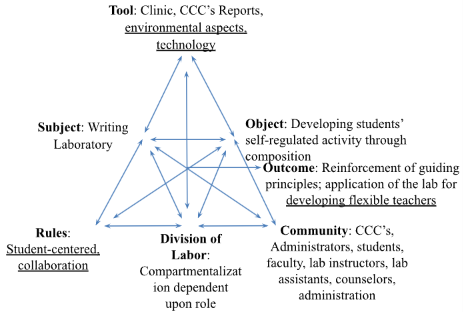
Figure 3. The continual development of the writing laboratory through CCC’s reports on laboratories and reflection on clinical experiments.
Peery’s work outlines the emerging system at the end of the Clinical Period. As shown in Figure 3, the clinic and CCC’s reports inform Laboratory praxis. Reverting to the Formative Period’s guiding principles, the emerging system rejects classification rules. The laboratory uses the clinic as an example of “what not to do” and the CCC reports to enhance its work. Adopting a student-centered, collaborative approach, the laboratory integrates technology, fosters a friendly environment, and uses the space to develop flexible teachers. With the CCC community’s inclusion, the lab evolves to not only serve as a writing lab but also a teaching lab.
Conclusion
It is my hope that this article and Liliana Naydan’s work may encourage readers to review rhetorical choices currently used among those who make up the writing center diaspora. By occupying an activist space, Naydan argues: “As writing center professionals reconstitute their identities to change dynamics involving academic freedom and shared governance at their respective institutions, they inevitably rework the narrative of their institutional histories as well as the narrative of writing center professionals broadly construed” (35). Thus, as a new era in writing center development begins to emerge, practitioners may be reminded through the work emerging out of the Clinical Period that the work found in modern-day writing centers has always been activist work. Practitioners continually respond to institutional contradictions by reshaping the rhetorical, pedagogical, and collaborative practices that govern our work.
From a CHAT perspective, this activism is not aspirational but structural: it emerges through historically accumulated contradictions within activity systems. Across the Formative and Clinical periods, writing instruction develops not through linear refinement but through recurring tensions among tools, rules, and divisions of labor that continually reorganize institutional practice. What appears as progress is, in Engeström’s terms, the outward trace of systemic contradiction generating new forms of activity.
Considering the ways in which we may begin looking for new ways to enrich our valuable writing center work, we may consider adopting strategies for developing a unified front for Writing Centers like that which is noted in the Workshop Reports. What if there were best practices for adopting terms we use in writing centers i.e., “writing assistants,” or “writing associates” as opposed to “tutors”? “Professional development” as opposed to “training”? By professionalizing our field, we can develop our ethos and improve our standing among academic departments. Further, the IWCA could offer guiding principles or best practices, like the WPA’s Writing Outcomes, more staunchly promoting Writing Centers as professional workplaces. Replicating the CCC’s Workshop Series model may also help address current Writing Center challenges, as noted by Naydan, and lead to a more centralized, unified system of Writing Center practice.
This is just a starting point, and I am not arguing for dramatic change here, but it is through the very collaborative activities that writing center practitioners promote that we can act as agents of activism for writing centers. Once the current contradictions have passed, we should be ready to establish new, lasting initiatives. From a CHAT perspective, interventions matter because they operate directly on the structure of activity systems: modifying mediating artifacts, reshaping rules, and redistributing labor in ways that alter the conditions of participation. Take for example the residue of the Clinical Period’s rhetorical choices created for the future of writing laboratories and centers. Some terms added to our lexicon during the Clinical Period include “diagnostics,” “diagnosis,” “remediation,” “tutor,” and “prescription." These and other terms adopted during the period served to create 'others' out of students who visited the writing laboratory for productive collaborations. In some instances, these terms still have a lasting negative effect on writing center work. Moreover, the carryover of some of these terms into our current centers may have helped erode our standing among the academic community leading to marginalized staff and poorly recognized faculty who serve under less-than-adequate working conditions.
However, moving beyond the Clinical Period does not mean abandoning its residue; rather, it requires confronting the contradictions it leaves behind. In Engeström’s terms, it is precisely the accumulation of unresolved contradictions within the activity system that makes expansive transformation both necessary and possible. In this sense, writing center history does not culminate in resolution but in renewed cycles of contradiction, in which practitioners expand the object of activity itself, thus redefining what counts as writing support, collaboration, and institutional responsibility. What may lay ahead, then, is not simply improved terminology or professional recognition, but the possibility of expansive transformation: new activity systems in which collaboration is not an ideal added onto practice, but the reorganizing principle through which writing center work is continuously remade in response to its own contradictions.
Endnotes
See: Appel, Francis S. “A Writing Laboratory.” Journal of Higher Education, vol. 7, no. 2, 1936, pp. 71-77.
Charles Scott explains, in 1894, the benefits for teachers in a laboratory system: “The teachers themselves are learning at the same time another lesson, no less important; that the school is a laboratory for them as well as their pupils . . .” (193).
See: Creek, Herbert L. “Forty Years of Composition Teaching.” College Composition and Communication, vol. 6, vol. 1, 1955, pp. 4-10.
Through his work, Wheeler introduces student volunteers into the community component of the CHAT frame.
Works Cited
Appel, Francis S. “A Writing Laboratory.” Journal of Higher Education, vol. 7, no. 2, 1936, pp. 71-77.
Bailey, J. O. “Remedial Composition for Advanced Students.” College English, vol. 8, no. 3, 1946, pp. 145-148.
Blunden, Andy. An Interdisciplinary Theory of Activity, Haysmarket, 2012.
“Clinical Aids to Freshman English: The Report of Workshop No. 14.” College Composition and Communication, vol. 4, no. 3, 1953, pp. 102-103.
“Composition Clinic at Wayne.” Higher Education, vol. 7, no. 2, 1950, p. 23.
Creek, Herbert L. “Forty Years of Composition Teaching.” College Composition and Communication, vol. 6, vo. 1, 1955, pp. 4-10.
Davydov, Vassily V. “The Content and Unsolved Problems of Activity Theory.” Perspectives on Activity Theory, edited by Yrjö Engeström, Reijo Miettinen, and Raija-Leena Punamaki, Cambridge UP, 1999, pp. 39-52.
Dewey, John. Democracy and Education, McMillan. 1944.
Engeström, Yrjö. “Expansive Learning at Work: Toward an Activity Theoretical Reconceptualization.” Journal of Education and Work, vol. 14, no. 1, 2001, pp. 133-156.
Fountain, Alvin M. “The Problem of the Poorly Prepared Student.” College English, vol. 1, no. 4, 1940, pp. 309-332.
Genung, John Franklin. “The Study of Rhetoric in the College Course.” The Origins of Composition Studies in the American College, 1875-1925, edited by John C. Brereton, University of Pittsburgh Press, 1995, pp. 172-177.
Godbee, Beth, et al. “Body + Power + Justice: Movement-Based Workshops for Critical Tutor Education.” The Writing Center Journal, vol. 34, no. 2, 2015, pp. 61-112.
Grimm, Nancy Maloney. “Retheorizing Writing Center Work to Transform a System of Advantage Based on Race.” Writing Centers and the New Racism, edited by Laura Greenfield and Karen Rowan, Utah State UP, 2011, pp. 75-100.
Johnson, W. G. “A Report on the University of Illinois Experimental Writing Clinic.” Illinois English Bulletin, vol. 33, 1945, pp. 9-13.
Mallam, Duncan. “A Writing Clinic at Iowa State College.” School and Society, vol. 57, no. 1463, 1943, pp. 51-53.
Marmon, Ina. “A Laboratory Method for English.” California Journal of Secondary Education, vol. 25, no. 5, 1950, pp. 268-270.
Moore, Robert. “The Upperclass Remedial English Courses at the University of Illinois.” Illinois English Bulletin, vol. 33, 1945, pp. 5-9.
---. “The University of Illinois Writing Clinic.” Illinois English Bulletin, vol. 36, 1948, pp. 9-11.
---. “The Writing Clinic and the Writing Laboratory.” College English, vol. 11, no. 7, 1950, pp. 388-393.
Naydan, Liliana M. “Toward a Rhetoric of Labor Activism in College and University Writing Centers.” Praxis: A Writing Center Journal, vol. 14, no. 2, 2017, pp. 29-36.
“Organization and Use of the Writing Laboratory: The Report of Workshop No. 9.” College Composition and Communication, vol. 1, no. 2, 1950, pp. 31-32.
“Organization and Use of a Writing Laboratory: The Report of Workshop No. 9.” College Composition and Communication, vol. 2, no. 4, 1951, pp. 17-19.
Peery, William. “Freshman English and the Enrollment Bulge.” Association of American Colleges Bulletin, vol. 41, no. 4, 1955, pp. 575-583.
Scott, Charles B. “Laboratory Methods in Elementary Schools.” Proceedings of the 1894 National Educational Association. St. Paul: National Educational Association, 1895. pp. 191-199.
Scott, Fred Newton. “Michigan English.” The Origins of Composition Studies in the American College, 1875-1925, edited by John C. Brereton, University of Pittsburgh Press, 1995, pp. 177-181.
Wheeler, Paul Mowbray. “Advanced English Composition: A Laboratory Course.” The English Journal, vol. 18, no. 7, 1930, pp. 557-566.
“Writing Clinics: The Report on Workshop No. 2.” College Composition and Communication, vol. 6, no. 3, 1955, pp. 125-126.
Vygotsky, L. S. Mind in Society, Harvard UP, 1978.