Praxis: A Writing Center Journal • Vol. 23, No. 4 (2026)
Reimagining Tutor Education for Multilingual Support: A Transfer-Informed Curriculum Grounded in Genre and Identity
Yan Li
Duke University
yan.li2@duke.edu
Abstract
As writing centers deepen their commitments to linguistic diversity and equity, tutor education must evolve to prepare peer educators for the complex rhetorical, linguistic, and ideological realities that multilingual writers navigate. This article responds to that expectation by offering a multilingual-inclusive approach to tutor education grounded in writing transfer studies and adjacent fields, including rhetorical genre studies and second language writing. Rather than treating transfer as a straightforward application of prior knowledge, this framework attends to how transfer is experienced as recursive, negotiated, and influenced by identity, language ideologies, and institutional norms.
Drawing on current scholarship that critiques the uneven accessibility of transfer for multilingual writers, the article presents a modular, adaptable curriculum designed to foster tutors’ metacognitive awareness of genre, language, and identity-embedded context. Six themed modules – each supported by assignments, reading recommendations, and articulated student learning outcomes – guide tutors through reflective narrative, genre analysis, discourse community observation, literature review, and research proposal writing. The curriculum invites tutors to engage in inquiry that connects transfer theory to tutoring practice and fosters strategies for supporting multilingual writers not just as learners, but as rhetorically confident participants in academic conversations. Rather than offering prescriptive strategies, the curriculum emphasizes reflection and conceptual engagement. It positions tutors as co-learners and negotiators, prepared to support writing transfer as a socially and ideologically situated process. This approach reimagines tutor education as a space for multilingual-inclusive, transfer-conscious writing support grounded in disciplinary research and critical pedagogy.
Keywords: multilingual writers; writing center pedagogy; tutor education; writing transfer; metacognitive genre awareness; curriculum design
Introduction
Writing centers are uniquely positioned to foster rhetorical, linguistic, and academic growth for multilingual writers navigating unfamiliar genres, disciplinary conventions, and institutional cultures. As spaces that operate across disciplines and outside traditional classroom structures, writing centers are also increasingly tasked with addressing learning transfer: how writers carry prior knowledge, strategies, and habits of mind into new and complex writing situations. In recent years, scholars have called for greater integration of writing transfer research into tutor education and session design (e.g., Bychkovska & Lawrence; Hill; Nowacek; Stock & Liechty). Yet while interest in transfer has grown, there remains a lack of systematic frameworks to help writing center administrators and tutor educators incorporate writing transfer research into multilingual-inclusive training. This article addresses that gap.
Writing transfer research has evolved over the past two decades to emphasize the social, dynamic, and learner-based nature of how writers repurpose knowledge across contexts (e.g., DePalma & Ringer; Nowacek; Wardle “Understanding”). In mainstream composition studies, pedagogical approaches such as Writing About Writing (WAW) and Teaching for Transfer (TFT) emerged from rhetorical genre studies (RGS) and adjacent fields, foregrounding metacognition, genre awareness, rhetorical flexibility, and writer agency as key conditions for transfer (e.g., Devit; Nowacek; Yancey, Robertson & Taczak; Wardle & Downs). Meanwhile, in the field of second language writing (SLW), researchers working in English for Academic Purposes (EAP) and English for Specific Purposes (ESP) have long developed genre-based pedagogies to help multilingual writers develop their metacognitive awareness of genre, language, and language ideologies (e.g., Bruce; Cheng; Gonzales; Hyland; Iwa; Johns; Monbec; Negretti; Tardy).
Although transfer-related research has developed along parallel trajectories, these traditions remain insufficiently integrated in tutor education. Mainstream tutor training has historically emphasized rhetorical listening, global revision, and minimalist directive strategies, often excluding linguistic concerns. SLW-focused instruction, by contrast, has emphasized explicit scaffolding of genre, sentence-level instruction, and language choice as a meaning-making resource. As Hill and Stock & Liechty have shown, writing center tutors are increasingly expected to support transfer with both focuses, but are often underprepared to do so without clear, theory-informed, pedagogical structures. What is often missing from tutor training is a pedagogical framework that brings these insights together: one that recognizes multilingual writers’ unique experiences of transfer and prepares tutors to facilitate metacognitive awareness of both genre and language as well as identity-embedded reflection in diverse consultation settings.
As recent studies have shown, tutors are open to discussing transfer and multilingual writing, but often feel underprepared to do so confidently or contextually. For example, Hill found that tutors introduced to transfer theory were more likely to engage students in “transfer talk,” yet still required conceptual support to integrate these moves consistently. Stock & Liechty observed that tutors resisted pre-scripted transfer prompts, preferring to adapt concepts to preserve rapport and peer ethos. Meanwhile, Cardinal and Driscoll highlight the potential of interactive staff development workshops that invite tutors to reflect on and articulate their prior knowledge and connect it to theories of genre and transfer. These studies suggest that tutors benefit from training that invites reflection, application, and experimentation, but that such training must be grounded in a clear conceptual model if it is to move beyond a less transfer-centered structure.
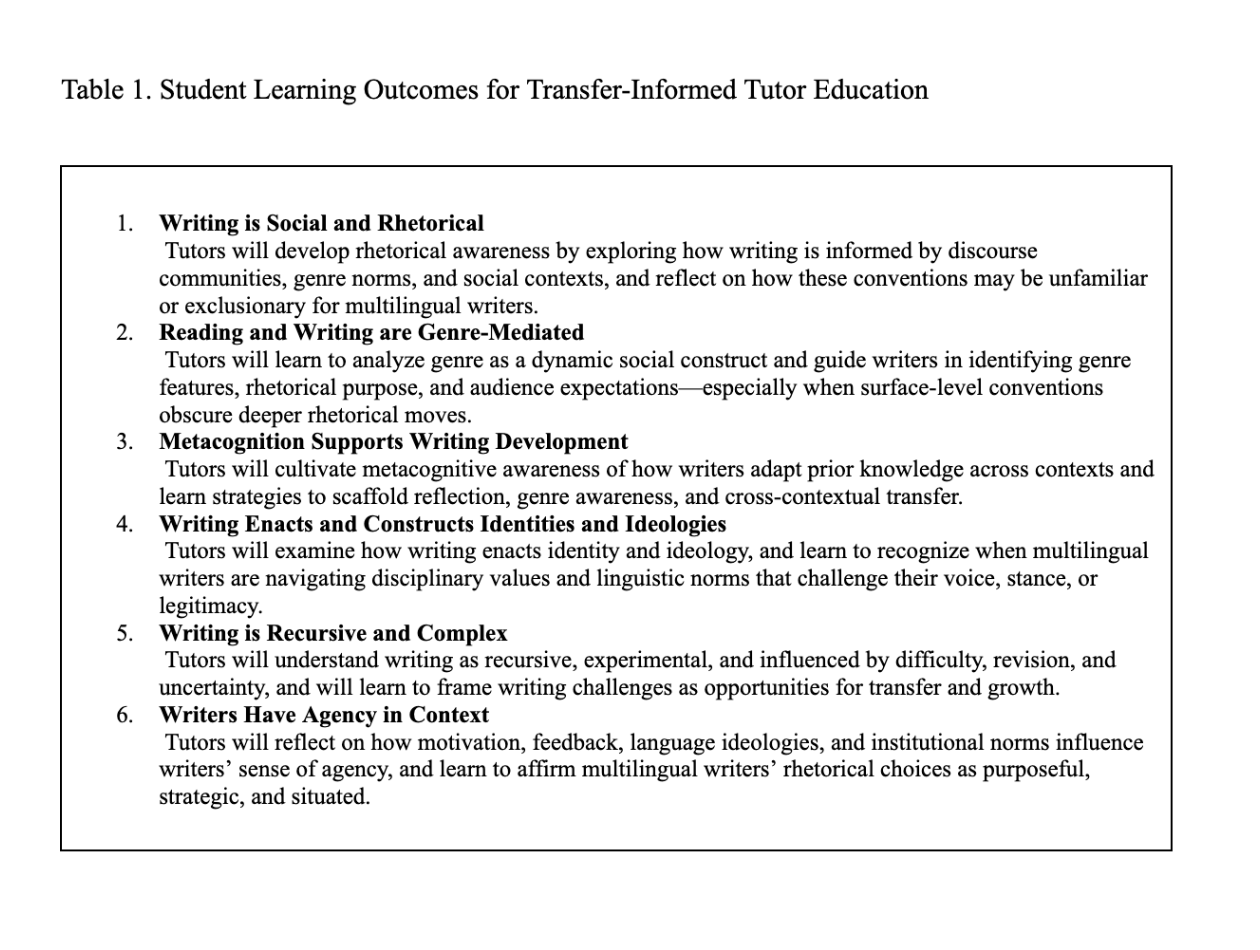
This article responds to these calls by revisiting the foundational claims of writing transfer research and tracing how these claims inform tutor education. Across this scholarship, six recurring themes emerge:
Writing is social and rhetorical
Reading and writing are genre-mediated
Metacognition supports writing development
Writing enacts and creates identities and ideologies
Writing is recursive and complex
Writers have agency and develop generative dispositions
While these themes are well established in the transfer literature, such as in threshold concepts (Adler-Kassner & Wardle) and the Writing About Writing (WAW) pedagogy (Wardle & Downs), they have not been systematically applied to multilingual-inclusive tutor education. Drawing from the cognitive-social and learner-based views of transfer, this article argues that tutor education can be reoriented to address the uneven, identity-embedded, and often invisible forms of transfer multilingual writers experience. In what follows, I review the transfer literature with attention to these tensions, before turning to the implications for writing center pedagogy for tutor education.
Literature Review
Cognitive and Social Views of Transfer: The Foundations of Operational Pedagogy
Early research on writing transfer emphasized the cognitive dimensions of how students apply prior knowledge to new rhetorical contexts (e.g., James “Transfer of Learning”; “Influence of Perceptions”). Drawing from educational psychology and composition studies, this work focused on identifying the mental strategies, schemas, and problem-solving skills that students transfer from one writing situation to another (Wardle, “Understanding”; Clark and Hernandez). Within this view, successful transfer is framed as the ability to recognize structural or procedural similarities across contexts and reapply familiar writing moves with rhetorical purpose. In writing pedagogy, this cognitive model often manifests through scaffolded instruction that helps writers acquire generalizable writing skills and apply them across closely related contexts, thereby supporting forms of near transfer.
Later scholarship in RGS challenged the notion that transfer is simply a matter of recognizing similarity. Instead, researchers reframed writing as socially situated, emphasizing how genre knowledge is constructed through participation in discourse communities and shaped by institutional expectations (Devitt; Nowacek; Reiff and Bawarshi; Yancey, Robertson, and Taczak). In this view, transfer becomes less about replication and more about recontextualization – the ability to adapt prior knowledge to meet new, often unfamiliar, rhetorical demands. For tutors, this shift means that supporting transfer involves more than reinforcing writing procedures; it requires helping writers understand genre as social action, and genre expectations as ideologically and institutionally situated.
Within writing transfer studies and adjacent fields, this cognitive-social synthesis has generated a robust set of pedagogical strategies for fostering transfer. For example, instructors are encouraged to facilitate genre awareness by analyzing rhetorical situations, audience expectations, and discourse conventions (e.g., Devitt; Swales & Lindemann; Johns; Tardy). Instructors or tutors also work to prompt metacognitive reflection, encouraging writers to articulate why they made particular choices and how those choices might shift in different writing contexts (e.g., Yancey et al.; Driscoll). These approaches offer a powerful toolkit for building rhetorical flexibility and helping writers develop strategies for generalizing knowledge across courses and assignments.
However, even as cognitive and social theories of transfer have informed curriculum design, they tend to assume that genre knowledge, once recognized, is accessible and actionable. This assumption can obscure the uneven conditions under which writers must transfer knowledge, especially in contexts marked by linguistic difference, institutional gatekeeping, and identity negotiation. As transfer scholars have noted, what appears to be a failure to transfer may in fact be a result of systemic misrecognition (e.g., Nowacek; Rounsaville). Moreover, the expectation that all students can "see connections" equally across genres or contexts does not account for how multilingual writers' rhetorical resources are often ignored, devalued, or misread within mainstream literacy frameworks.
Thus, while cognitive and social models provide essential foundations for tutor education, especially in teaching metacognitive genre awareness, they do not fully account for the affective, agentive, and institutional conditions that both constrain and enable multilingual writers’ transfer experiences. In the next section, I turn to learner-based and identity-embedded perspectives that complicate these assumptions and offer a more nuanced understanding of how transfer unfolds in the writing process, particularly for multilingual students navigating unfamiliar genres, linguistic norms, and power dynamics.
Learner-Based Views of Transfer: Identity-Embedded Adaptation
More recent scholarship has complicated the assumption that transfer is always accessible, neutral, or desirable. Learner-based perspectives on transfer foreground the ways writing knowledge is taken up or constrained by writers’ identities, affective histories, and the institutional conditions under which writing is evaluated (Nowacek; Wardle “Creative”; James “Transfer Clilmate”; Driscoll & Wells). From this perspective, transfer is not simply a matter of recognizing rhetorical similarity or applying genre awareness, but a process informed by how writers interpret expectations, assess risk, and negotiate legitimacy within uneven academic systems.
This line of inquiry has been particularly influential in challenging celebratory accounts of rhetorical flexibility. Flores, for example, offers a sharp critique of pedagogies that valorize adaptability, plurilingualism, and transfer without interrogating the political and economic contexts in which such traits are rewarded. He argues that educational discourses emphasizing flexibility and lifelong learning may align more closely with neoliberal ideals of the “enterprising self” than with the interests of multilingual communities historically marginalized by academic institutions. From this vantage point, asking students to “transfer” knowledge across contexts can function as a form of coercion in pressuring writers to accommodate dominant norms while leaving unjust institutional cultures intact. Flores’s intervention cautions against treating transfer as an inherently emancipatory goal and calls instead for attention to whose interests transfer serves and under what conditions.
Transfer scholars working in writing studies have raised parallel concerns, particularly in studies that examine moments where transfer breaks down or is misrecognized. Rounsaville’s work on genre uptake demonstrates that writers often draw on prior knowledge in ways that are rhetorically sound yet institutionally unvalued, especially when antecedent genres do not align with academic expectations. Similarly, Wang’s analysis of transnational literacy practices shows how multilingual writers’ adaptive strategies may be rendered invisible or even penalized within monolingual assessment regimes. These studies suggest that what appears as a failure to transfer may instead reflect institutional unwillingness to recognize the rhetorical repertoires of underrepresented writers’ choices.
From a learner-based perspective, then, transfer is inseparable from questions of identity, power, and attribution. Writers must not only decide how to adapt prior knowledge, but whether doing so is worth the risk. James’s (“Investigation of Motivation”; “Transfer Climate”) research on transfer climate and motivation illustrates how students’ willingness to attempt transfer is influenced by prior experiences of feedback, assessment, and perceived alignment with instructors’ values. Wardle’s (“Creative”) distinction between problem-exploring and answer-getting dispositions further underscores how institutional signals about correctness and success can narrow writers’ engagement with unfamiliar genres. For multilingual writers in particular, these dynamics are intensified by language ideologies that frame deviation from standardized norms as error rather than rhetorical choice.
At the same time, learner-based critiques of transfer do not abandon genre or metacognition; rather, they call for pedagogies that make ideological dimensions of writing explicit. Recent work in second language (L2) writing studies offers concrete examples of how such pedagogies can be enacted. Di Gennaro, Choong, and Brewer’s integration of Critical Language Awareness (CLA) with WAW, grounded in research from second language acquisition (SLA), demonstrates how explicit attention to written language can help students interrogate dominant norms while developing transferable knowledge about how writing works. By centering language as both the content and object of inquiry, this approach enables students to analyze how genre expectations are constructed, enforced, and unevenly applied.
Importantly, CLA-informed pedagogies position writers as decision-makers rather than adapters. When students learn to observe, describe, and critique linguistic patterns in context, they gain tools not only for transferring knowledge, but for evaluating when and how transfer is warranted. This orientation aligns with the learner-based view of transfer that emphasizes agency and attribution: writers are supported both in understanding why certain choices are valued in some contexts and contested in others, and in deciding how they wish to respond. For multilingual writers, such explicit discussion of written language and language ideologies can transform transfer from an assimilative demand into a site of reflective negotiation.
Taken together, the learner-based view with an identity-embedded focus reveals why transfer remains difficult to operationalize in writing center contexts. Tutors often encounter writers at precisely the moments where genre knowledge, linguistic identity, and institutional expectations collide – moments that cannot be resolved through generic advice or ideology-free genre awareness alone. Understanding transfer in these terms shifts the role of tutor education: from teaching tutors how to promote transfer abstractly, to preparing them to recognize, name, and support the complex interpretive work multilingual writers are already doing as they navigate asymmetrical writing cultures.
These evolving views of transfer, particularly those that foreground identity, affect, and institutional power, have significant implications for tutor education. While writing centers have long emphasized collaboration and metacognitive genre awareness, tutor preparation rarely addresses the full complexity of transfer as a negotiated, learner-dependent process. If transfer involves not only applying prior knowledge but also interpreting, resisting, or reworking it under shifting conditions, then tutors can be trained and mentored to recognize such moments and respond with more than genre types or revision heuristics. What multilingual writers often need is not correction but conversation: a space to articulate their reasoning process, assess their options and risks, and develop language for rhetorical decision-making. This shift requires reimagining tutor education as more than skills-based, ideology-free training; it can become a site for cultivating conceptual knowledge, reflective practice, and critical awareness of how transfer works (and how it doesn’t) within the linguistic and cultural realities of higher education.
Designing Transfer-Informed Tutor Education: A Curriculum for Multilingual-Inclusive Praxis
Writing center tutors are often asked to support multilingual writers as they navigate unfamiliar genres, disciplinary expectations, and language norms, yet tutor education may not prepare them for the conceptual demands of this work. Many tutors enter their roles with training centered on peer feedback strategies and general revision practices, but without sustained engagement with writing studies, genre theory, or transfer research. As a result, tutors may recognize that writers are struggling with rhetorical or linguistic decisions but lack the vocabulary and confidence to name what is happening or to respond in ways that support learning across contexts. Research on multilingual tutoring has shown that genre-trained tutors are most effective when they are prepared to analyze texts rhetorically, discuss language choices as meaningful, and engage writers in reflective conversations (Malenke et al.).
To address these gaps, this section outlines a multilingual-inclusive tutor education curriculum grounded in writing transfer theory and centered on the lived experiences of multilingual writers. Building on the view of transfer as dynamic, recursive, and identity-embedded, the curriculum responds to the realities that these writers face – not only in transferring genre knowledge, but in negotiating language, voice, ideology, and institutional norms. It draws from cognitive, social, and learner-based perspectives to help tutors recognize that transfer is not simply about applying prior knowledge, but about navigating rhetorical expectations that are often unfamiliar, implicit, or unequally enforced. Writing centers are frequently the first space where these negotiations become visible in moments of uncertainty, misalignment, or perceived failure. To prepare tutors for this complexity, the curriculum invites them to:
read and engage with writing theory
reflect on their own writing experiences
analyze genre and discourse practices
participate in inquiry-based work that bridges conceptual knowledge and peer collaboration
This curriculum positions tutors as co-learners and rhetorical thinkers prepared to support writers navigating the difficult, and sometimes inequitable, terrain of academic transfer. What does it mean to support writing across linguistic, cultural, and disciplinary boundaries? How do tutors help multilingual writers navigate unfamiliar genres without reinscribing dominant norms? What kinds of questions, feedback, or conversations foster agency, reflection, and rhetorical experimentation rather than correction or conformity? These are the questions that animate a transfer-informed approach to tutor education – one that treats writing development as both conceptual and relational. Tutor training, in this model, becomes a space for grappling with complexity through reading, reflection, discussion, and practice.
What follows is a modular, adaptable curriculum designed to prepare tutors to support multilingual writers through the lens of writing transfer. Drawing from my previous teaching experience and ongoing research into genre-based, transfer-conscious support, this curriculum positions tutors not as translators of academic discourse, but as co-learners and co-constructors of writing knowledge. I offer assignment ideas and recommended readings that help tutors connect transfer theory to multilingual writing support through genre analysis, reflective inquiry, and sustained attention to identity and institutional context.
Assignment Recommendations for Transfer-Oriented Tutor Education
To design a transfer-encouraging tutor education curriculum, I propose the following assignment options, each designed to help tutors reflect on their own writing development while engaging with multilingual writing through the lens of genre, identity, and transfer. These assignments are not presented as a fixed sequence, but as components that can be adapted across credit-bearing courses, training workshops, or professional development series. They are flexible in structure and can be selected or sequenced based on local needs, supporting tutors to develop the habits of reflection, rhetorical inquiry, and linguistic awareness essential to encouraging writing transfer..
My Voice Story – A Reflective Narrative
This assignment invites tutors to reflect on their own lived experiences as writers, language users, and meaning-makers. Rather than asking tutors to define “good writing” in abstract terms, this assignment encourages them to trace how their writing beliefs and language choices have been cultivated by schooling, family, linguistic heritage, disciplinary expectations, and moments of feedback or constraint. Tutors might explore the genres they grew up writing in, the voices they learned to adopt or suppress, or the languages they navigate and translate across contexts.
By narrating and reflecting on these experiences, tutors begin to develop metacognitive awareness of how rhetorical knowledge is acquired, challenged, or adapted over time. This builds empathy for writers negotiating new genre expectations, and helps tutors recognize that transfer is not automatic but is embedded in identity, culture, and power. The assignment may take the form of a literacy narrative, language memoir, or multilingual voice story. Tutors are encouraged to think not just about what they write, but about how and why their writing voice has taken shape and how that can inform their practice as peer tutors.
Genre Analysis or Discourse Community Ethnography
This assignment offers tutors two complementary pathways into understanding genre and discourse community as social, rhetorical, and identity-embedded concepts. Tutors may choose to conduct a genre analysis, selecting a writing form commonly encountered in academic, professional, or everyday contexts, such as a lab report, personal statement, literature review, social media post, or spoken word performance. They then analyze its rhetorical features: purpose, audience, tone, structure, and the cultural or disciplinary expectations it enacts. This analysis helps tutors develop genre awareness while surfacing how genre norms may be unfamiliar, shifting, or tacit for multilingual writers navigating mainstream literacies.
Alternatively, the discourse community ethnography invites tutors to observe how writing mediates participation, authority, and identity within a specific academic or professional setting. By studying the communication practices of a particular discipline or community through interviews, artifacts, or observation, tutors can begin to see genre not just as form, but as social action influenced by values, hierarchies, and ideologies. This broader lens supports tutors in recognizing how genre knowledge is acquired and performed over time, and how multilingual writers might be positioned differently depending on their access to that knowledge. Whether working with genres or communities, this assignment helps tutors move from seeing genre as a template to understanding it as a dynamic resource for negotiation.
Literature Review: Entering the Scholarly Conversation on Writing Transfer
This assignment invites tutors to enter the disciplinary conversation around writing transfer by researching and synthesizing peer-reviewed scholarship in writing studies. Tutors explore a research question related to multilingual writing support, such as genre uptake, feedback across languages, learning dispositions, or metacognitive reflection on writing identity, and locate six to ten scholarly sources that engage this question. Their goal is not only to summarize the research but to map the conversation: What is currently known? Where do perspectives diverge? What voices or experiences are missing from the discourse?
By taking on the role of researcher, tutors begin to see themselves not just as responders to student writing, but as scholar-practitioners who contribute to knowledge about writing and learning. The assignment supports metacognitive awareness of how theory translates into pedagogy, and how multilingual writers and tutors themselves navigate power, identity, and transfer in institutional contexts. A lower-stakes annotated bibliography, research log, or reading journal can serve as scaffolding to help tutors process texts before composing their review. This assignment reinforces the idea that supporting writing transfer requires not only practice, but participation in a larger community of inquiry.
Writing Center Conference Proposal
This assignment invites tutors to conceptualize a future research or professional presentation based on an idea that has emerged from their tutor education. Rather than conducting a full research project, tutors identify a question, tension, or pattern they have begun to observe, often sparked by their literature review or session reflections, and develop it into a proposal suitable for a writing center conference, staff development presentation, or campus research forum. The purpose of the assignment is not to present conclusions, but to practice entering a disciplinary conversation by posing meaningful questions and proposing an inquiry-based or pedagogical contribution. Tutors consider what perspectives are missing in current practices, what needs their peers or writers have, and how they might begin to investigate or address those issues. This process models sustainable engagement with the field, encouraging tutors to see professional and scholarly inquiry as a natural extension of their reflective work.
Methodology, data collection, or implementation plans may be gestured toward as part of the proposal’s scope, but they may not be expected to be completed within the timeline of a one-semester tutor training course. If time and curriculum allow, this assignment can be expanded into a final research paper or professional development project. Tutors may also revisit this proposal in mentoring programs, future staff roles, or institutional initiatives related to multilingual writing support and transfer pedagogy.
Final ePortfolio and Tutoring Philosophy
As a capstone to the curriculum, this assignment invites tutors to curate a final reflective ePortfolio that synthesizes their learning across the course or training program. The portfolio may include selected artifacts, such as the reflective narrative, genre analysis, discourse community ethnography, literature review, consultation reflections, or drafts of a writing center proposal, all framed by a tutoring philosophy that serves as a cover letter for the collection. This philosophy introduces the tutor’s evolving understanding of multilingual writing support and contextualizes their growth as a peer educator.
Tutors are encouraged to revisit their earlier writing and lived experiences to examine how their beliefs about writing have been informed by engagement with concepts like writing identity, language ideologies, and disciplinary norms. In doing so, they make visible how knowledge is carried, questioned, or repurposed across contexts – not as a simple process of application, but as an act of negotiation. The goal is not only to reflect, but to make previously tacit beliefs and literacies visible and teachable to themselves and to others. This assignment supports both metacognitive awareness and professional confidence, preparing tutors to articulate what they know about writing development and why it matters in diverse academic writing contexts.
Tutors may present their philosophy in a format of their choice, such as a written statement, multimodal composition, digital artifact, or oral presentation. Regardless of form, the portfolio becomes a space for tutors to name their knowledge, claim their growth, and connect their tutoring practice to broader disciplinary conversations about language, power, and access for multilingual-inclusive writing support.
Reading Recommendations for Transfer-Informed Tutor Education
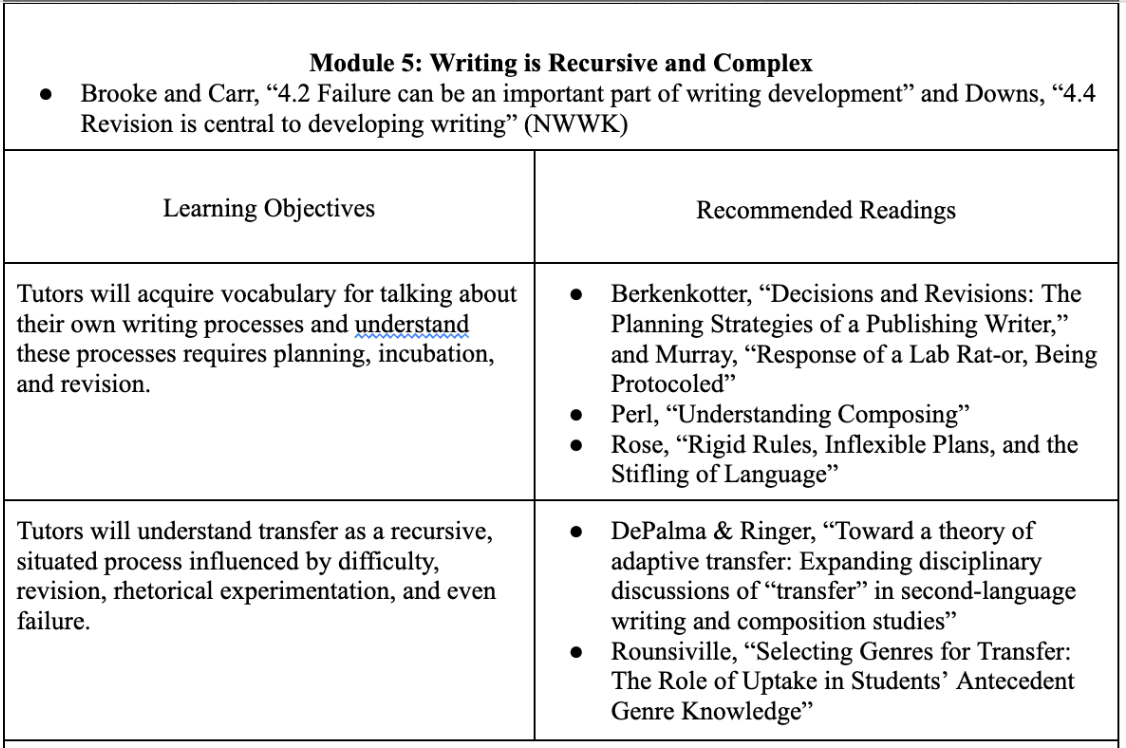
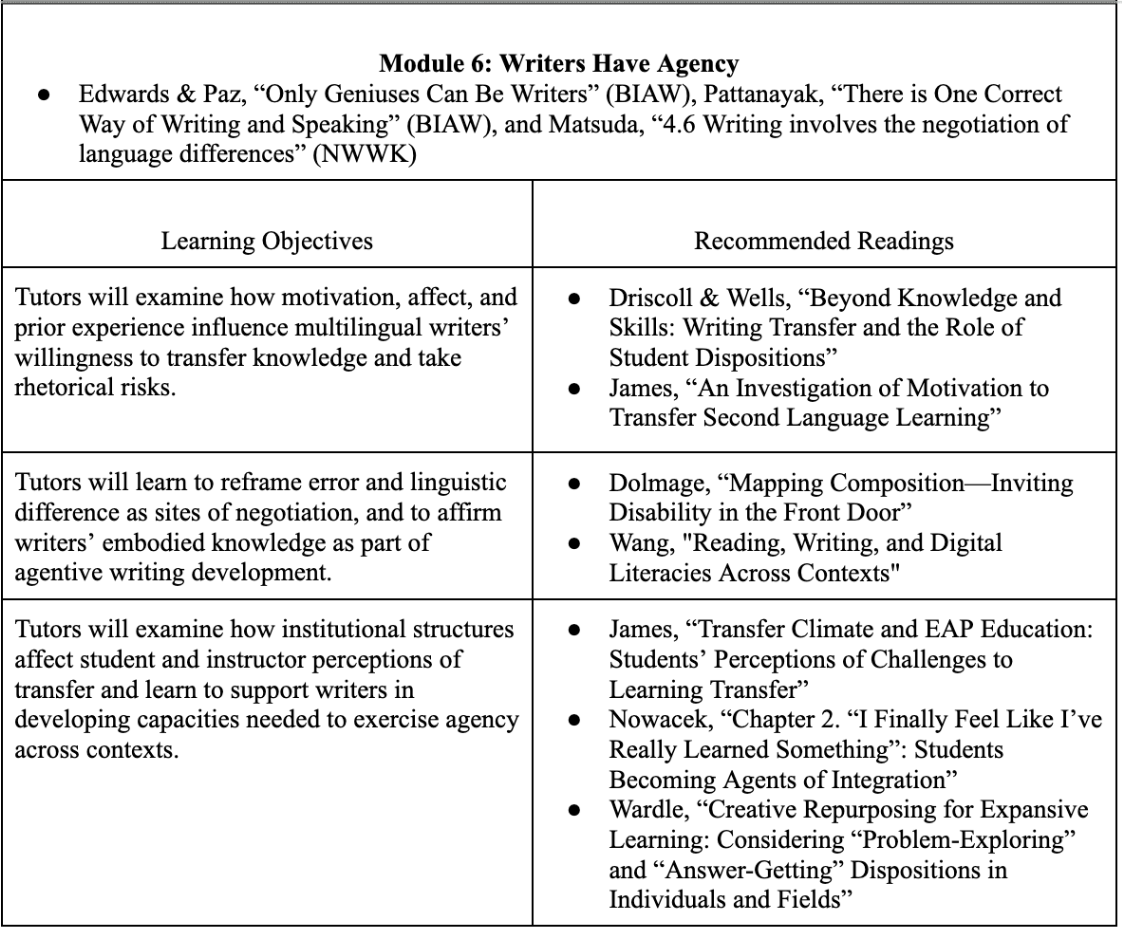
Reading assignments are a central component of this transfer-informed tutor education curriculum. Aligned with research in writing transfer studies and adjacent fields, the readings help tutors engage abstract concepts through reflection, analysis, and application. Rather than functioning as background knowledge or static content, these modules serve as pathways through which tutors develop a methodological orientation toward metacognitive genre awareness and critical sensitivity to language, power, and identity.
The curriculum scaffolds tutors’ learning across major assignments by pairing each project with a carefully curated set of texts drawn from scholarship in writing transfer and adjacent fields such as second language writing and rhetorical genre studies. These readings build foundational knowledge on composing processes, genre and discourse community, language ideologies, multilingual literacies, and transnational identity in writing development. More importantly, they help tutors approach writing transfer not as straightforward transportation of knowledge, but as a complex process influenced by social positioning, feedback histories, institutional norms, and intercultural negotiations.
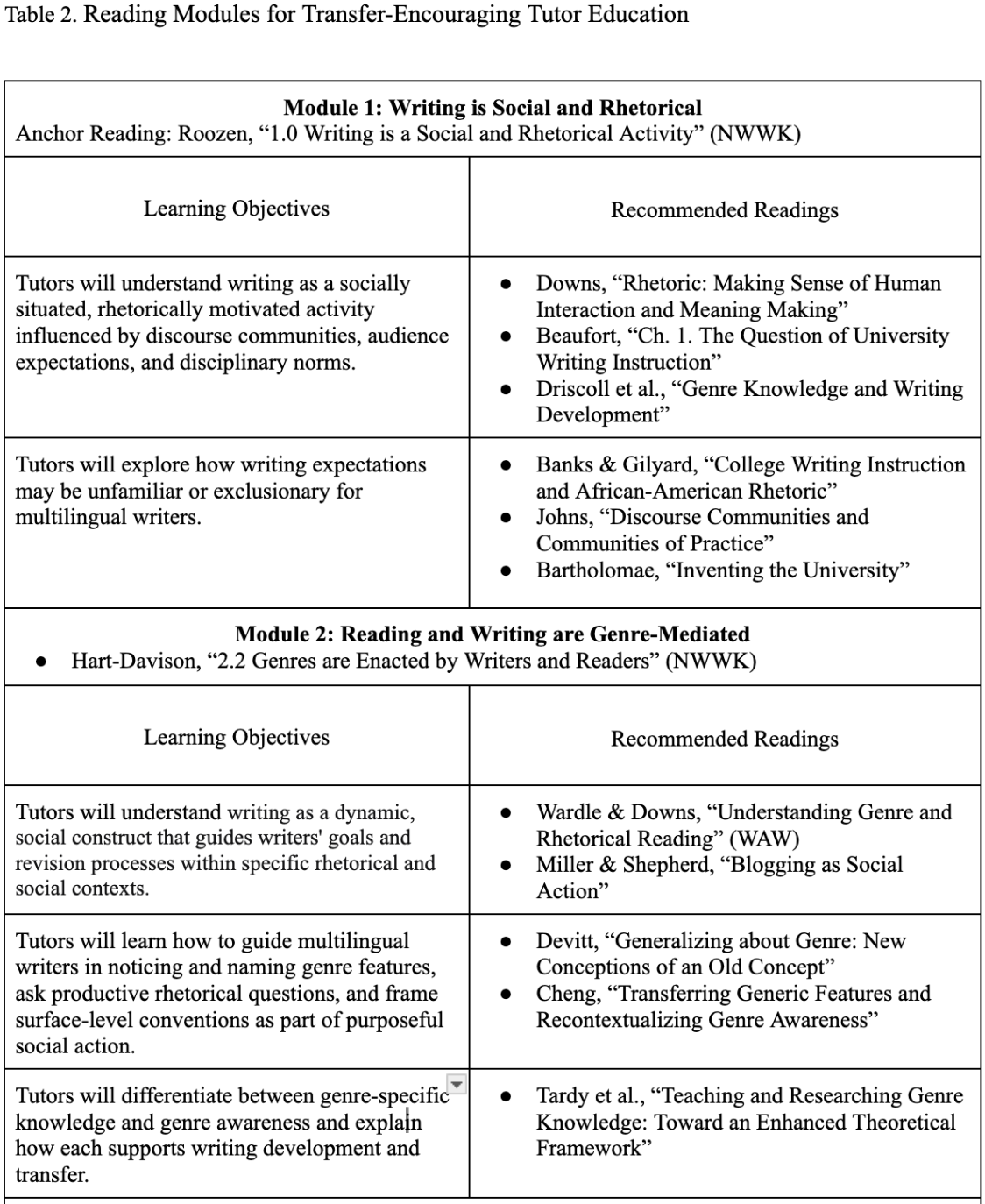
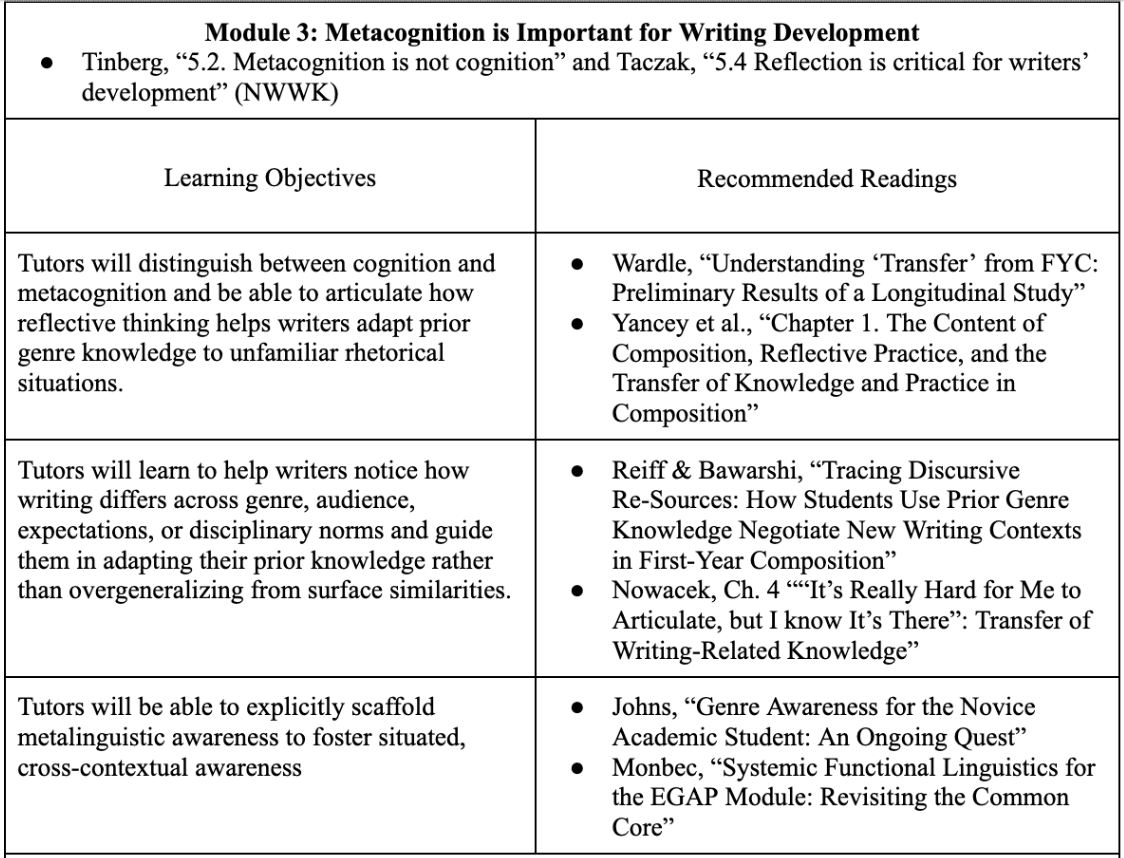
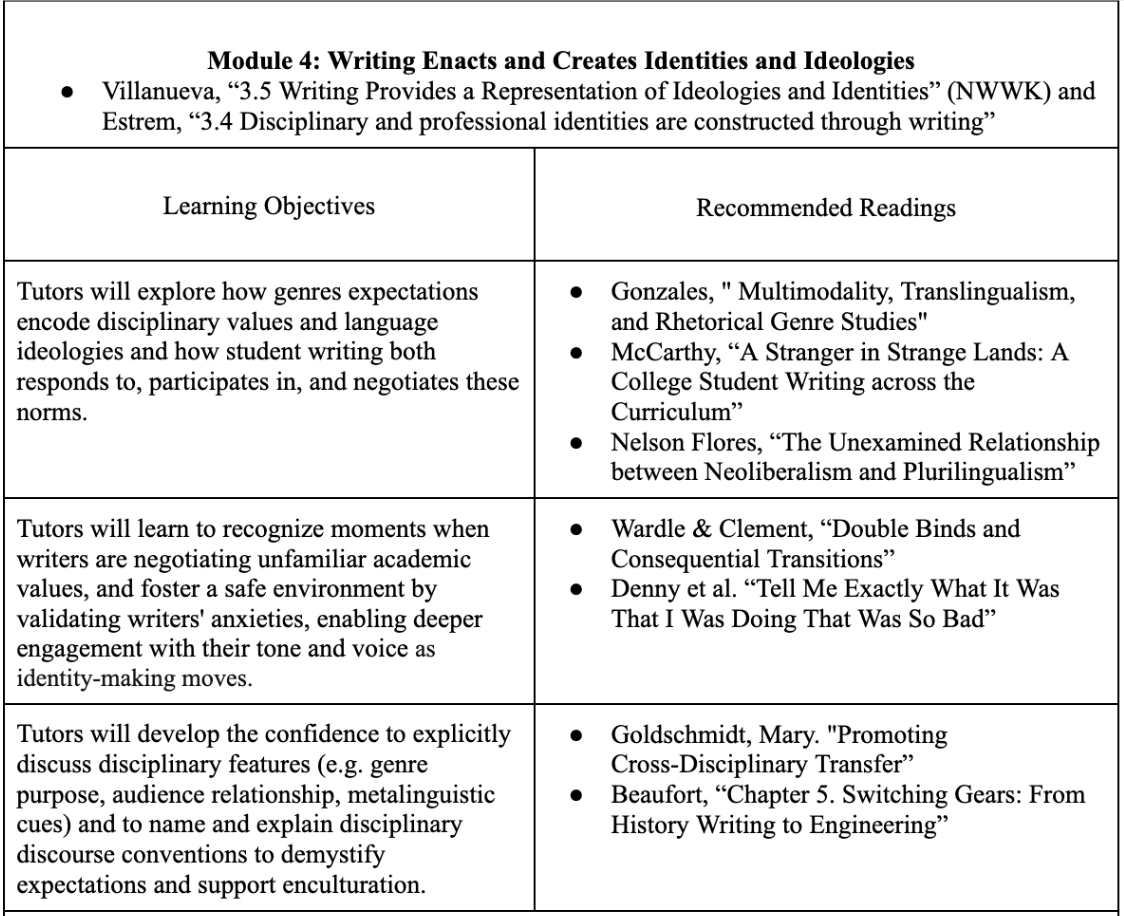
Reading Modules for Transfer-Informed Tutor Education
The tables provided in the Appendix outline six themed modules, each organized around a central learning focus and paired with recommended texts. Each module begins with short chapters from Naming What We Know (NWWK) or Bad Ideas About Writing (BIAW), which introduces the module’s threshold concept or contested assumption. The reading selections are curated to support tutors in developing key concepts introduced earlier in this article – rhetorical awareness, genre knowledge, metacognitive reflection, and critical engagement with language, power, and identity. The modules are not intended as prescriptive content, but as adaptable scaffolds. Readers are encouraged to select, substitute, or expand readings based on institutional goals, program structure, and student populations. (See Appendix.)
This study used a qualitative description approach to assess student tutors’ insights about emotional intelligence, the training they received in our writing center, and other thoughts about their experience as tutors during the Fall 2024 and Winter 2025 semesters on our writing center team. The aim of the study was to collect data in an effort to learn the opinions and perspectives of tutors in our writing center who received specific training about the relationship between emotional intelligence and the work of a writing tutor. A qualitative description approach methodology provided rich discussion points for tutors to share their experiences and hear from each other throughout the discussion. This made it possible to highlight the voices of the tutors, ensuring that the findings were grounded in their actual experiences.
The qualitative data was collected during one focus group session lasting approximately 35 minutes. The focus group included four pre-written open-ended questions. During the focus group, we anticipated the potential need to skip questions for time or to substitute some questions with relevant follow-up questions (all questions can be seen in Appendix B). Each focus group question was tailored to identify the perspectives of our writing center’s tutoring staff about their experience with their work as it relates to emotional intelligence. We recruited five (5) student tutors who started in our writing center during Fall of 2024 (when we implemented training on emotional intelligence) and who were still employed during the Summer of 2025. Of those 5, three (3) tutors were available to attend the focus group session. All tutors were provided with a research sheet that stated the purpose of the research and were informed that participation is not mandatory, but appreciated.
Upon completion of the focus group session, the written transcript was uploaded to a password protected shared document for both Amy and Grace to review. Once the data were shared, we read through the responses and applied codes according to our own reading and analysis of the data set. We applied thematic codes to the data set using the comment function in Google Docs. The entire transcript was coded twice. When the independent coding was complete, both team members met, using peer debriefing and support, to discuss the existing codes and their themes. Upon completion of both rounds of coding, Grace created a table detailing the themes of the transcript data as well as relevant quotes for each theme. Subsequently, Amy and Grace reviewed the codes, condensing repetitive codes and deciding on specific language for each code. Then, each code was categorized into its respective theme. From there, the themes were reviewed again for consensus.
Conclusion
This article has proposed a multilingual-inclusive approach to tutor education grounded in evolving theories of writing transfer. By synthesizing insights from writing transfer, rhetorical genre studies, and second language writing – and by tracing a progression from cognitive and social models to learner-based, identity-embedded perspectives – this article responds to a pressing need in the field: to better prepare tutors for the complex rhetorical, linguistic, and ideological negotiations multilingual writers face in U.S. higher education. Through its modular curriculum, assignment options, and reading recommendations, this project offers writing center educators a flexible design for fostering tutors who are not only genre-aware and metacognitively reflective, but also rhetorically attuned to the power dynamics that condition writing development.
Designing tutor education through the lens of transfer is not simply a matter of instructional technique; it is a call to reimagine what it means to support multilingual writers under the current political climate. The curriculum outlined here enacts that reimagining by treating multilingualism not as a barrier to transfer, but as a resource for writer agency. It also responds to growing consensus among writing center scholars that tutor education must move beyond ad hoc methods to cultivate tutors capable of thinking rhetorically, reflectively, and critically about language and learning (Hill; Bychkovska & Lawrence; Malenke et al.). When tutor education acknowledges transfer as partial, situated, and unevenly distributed, it becomes a space where writers and tutors alike can engage in meaning-making, negotiation, and growth.
While this curriculum has not yet been implemented as a full tutor education program, its design is informed by my teaching experience in first-year and advanced writing courses, where I have incorporated similar assignments and conceptual frameworks. In these contexts, I have observed that students often develop increased awareness of how audience expectations differ across genres and disciplines, but also struggle to adapt prior knowledge in ways that align with new rhetorical situations. These moments of difficulty frequently reflect not a lack of knowledge, but an uncertainty about how to interpret expectations or negotiate conflicting norms. For multilingual students in particular, rhetorical strategies grounded in prior linguistic and cultural experiences are sometimes misread or undervalued within academic contexts. These observations suggest that tutor education must prepare consultants not only to support metacognitive genre awareness, but also to recognize and respond to the uneven, identity-embedded conditions under which transfer occurs.
Future research is needed to explore how multilingual writers and tutors co-construct transfer in real time: in sessions, across semesters, and throughout the institution. We need more sustained inquiry into how writing center pedagogies can foreground linguistic justice and self-representation without reducing transfer to skill adaptation or genre mimicry. How do tutors support transfer without reinscribing dominant language ideologies? How do we prepare tutors to notice, affirm, and reflect on writers’ rhetorical choices – even when those choices resist dominant norms? These are urgent and generative questions for writing center research and practice. As the field continues to deepen its commitments to equity and access, tutor education must evolve as a space for transfer-conscious, multilingual-inclusive intellectual work.
Acknowledgment
The author gratefully acknowledges Dr. Eliana Schonberg for sharing the tutor education curriculum that served as the foundation for my teaching of tutor education. I am deeply grateful for her mentorship, thoughtful guidance, and the autonomy she entrusted to me as I adapted the course and explored new pedagogical approaches. Her support has been invaluable to my development as an educator and to the work presented in this article.