Praxis: A Writing Center Journal • Vol. 23, No. 4 (2026)
Talking to the Students Behind the Drafts: Results from a Focus Group Study on Asynchronous Instruction
Lisa Marvel Johnson
University of Wisconsin-Madison
lmjohnson32@wisc.edu
Samitha Senanayake
University of Wisconsin-Madison
sssenanayake@wisc.edu
Abstract
Asynchronous instruction has long been a staple of writing center teaching, yet relatively little research has examined how students experience and make meaning from different feedback styles. In order to give insight into students’ perspectives, this article details the results of a research study in which students received three different styles of asynchronous feedback on their drafts: (1) global comments with marginal comments, (2) marginal comments with track changes, and (3) marginal comments alone. Based on analysis of focus group transcripts with these students, our findings complicate common assumptions about asynchronous instruction and directive feedback. Participants demonstrated nuanced, non-linear ways of engaging with feedback that highlighted their own agency and complex decision making. Preferences for feedback styles varied widely based on individual disposition, writing stage, and affective response, and thus we argue that offering multiple feedback styles to students can best support these varied preferences and learning styles. By centering the voices of students behind the drafts, this study highlights the dialogic possibilities of asynchronous feedback and calls for greater pedagogical flexibility in writing center practice.
Keywords: Asynchronous tutoring, track changes, feedback styles, student learning, focus groups, student perspectives
Introduction
Asynchronous instruction has long been a fixture of our writing center at our large public Midwestern land-grant university. For more than a decade, students have been submitting their drafts and our team of graduate student tutors have returned these drafts with written comments–a modality that we call “Written Feedback.” In 2026, we offer (and typically fill) over fifty Written Feedback appointments per week. Despite the ubiquity and longevity of this modality at our center, we felt unsure of how students were experiencing these appointments before engaging in the research project that this article discusses. Unlike in a synchronous setting where tutors are able to gauge students’ attitudes and dispositions, this is not possible in the case of Written Feedback because there is no synchronous meeting that accompanies the feedback. Especially in the case where a student did not make subsequent appointments, it was difficult to know how students were interpreting the feedback, whether they understood the suggestions we were making, whether they felt empowered to make edits to their work, and how they felt about our comments. We wanted to be able to have conversations with the students behind the Written Feedback drafts in order to answer some of these persistent questions.
Purpose of the study
At our writing center, tutors are asked to provide global comments and marginal comments on every Written Feedback draft that they respond to. The global comment is a summary comment that describes the strengths and areas that could be improved in the draft. It is meant to contextualize and distill themes in the feedback. The marginal comments respond to the draft at the sentence level. They allow the tutor to give praise or identify places where revision would be helpful. In the latter case, tutors also give options for revision in the comment. Tutors are trained to give feedback through a proseminar in general writing center tutoring, specific orientations for Written Feedback instructors, and ad-hoc trainings throughout the semester from our Teaching Assistant Online Writing Center Coordinator. Although it is not explicitly recommended in our pedagogy, we noticed that tutors were using track changes in order to make limited edits to some drafts. In order to determine which kinds of comments were helpful to students and if we could endorse using track changes, we decided to study three different styles of feedback, which included global comments, marginal comments, and track changes through a series of focus groups with student writers.
While scholarship on asynchronous feedback has studied the uniquely discursive potential in asynchronous feedback as a form of writing instruction, our study describes how each writer imagines learning and what is helpful in the feedback. Although previous research about written feedback has analyzed the feedback itself, our inquiry centers the experience of writers. For these reasons, our work makes important advancements into understanding students’ reactions to receiving feedback and the revision process.
Literature Review
Asynchronous feedback
One challenge with adapting the modality of asynchronous feedback for writing center instruction is that it appears to resist conversation and dialogue, paradigms which constitute the “lore” (Adepoju 4) and the “key idea behind writing centers” (Raforth 146). Castner argues that asynchronous instruction lacks the sustained dialogue necessary to facilitate learning (122) and others recommend extensive correspondence between the tutor and student in the case of asynchronous instruction in order to approximate the learning in a face-to-face scenario (Coogan; Breuch and Racine), signaling a certain level of trepidation when it comes to asynchronous feedback in the context of the writing center.
However, studies conducted first by Dimitar Agelov and Lisa Ganobcsik-Williams and then by Olalekan T. Adepoju expand what conversation and dialogue looks like outside of face-to-face interactions in the writing center context. In an analysis of interviews and drafts from asynchronous writing tutorial sessions, Dimitar and Ganobcsik Williams argue that these tutorials are effective at achieving dialogue between the student and the tutor and a balance of directive and non-directive feedback, despite the lack of synchronous interaction (48).
Continuing this line of thinking, Adepoju highlights the way that conversation in asynchronous feedback unfolds in three phases: an opening phase which is comprised of the information provided by the writer, the dialogic phase which consists of in-text comments, and a closing phase which includes the headnote provided by the tutor (11).
While these studies clearly demonstrate the potential for dialogue through feedback types such as in-text comments and global feedback, we wished to explore how different combinations of feedback types may contribute to or diminish this conversation. Building on this previous research, our study tests out various positionings of feedback on the page and the use of different technologies such as track changes to deliver the feedback. Our research asks whether what is perceived as the most directive form of feedback (track changes) can be beneficial to student learning and can carry on the types of conversations that are integral to the project of the writing center. Additionally, while both these studies perform analyses of drafts and feedback and draw from interviews with writers and tutors, our study focuses exclusively on the writer’s perspective on learning, further centering an understanding of student needs. By asking students which types of feedback they find the most useful and what types of feedback help them learn the most, we are able to dive into the particularities of how asynchronous instruction can be delivered to maximize student benefit.
Track changes
Track changes have not been traditionally a part of prescribed writing center pedagogy. Instead of focusing on “local” concerns like grammar and sentence construction, tutors are encouraged to prioritize “global” matters that are related to the structure of the draft or other overarching concerns. Writing center tutors who are defined in opposition to proofreaders or editors are taught to “improv[e]” the writer, not the draft (Hawthorne 1). Furthermore, tutors are encouraged to avoid directiveness and encourage collaboration between themselves and the student (Thompson et. al. 79). This pedagogical approach is certainly alive at our writing center. Our standard advice to tutors providing Written Feedback (where proofreading or editing may be especially enticing) is that they should provide lessons in their feedback, give options for revision, and avoid “correcting” a student’s draft. Track changes, on the other hand, can be directive, provide students with only one option for revision, and do not allow space for giving students lessons about their writing.
This attitude towards track changes is reflected by many writing centers. For example, De Herder mentions that he worked in a writing center where track changes were explicitly prohibited, and instead tutors were asked to write out the “errors” that they had found in a student’s draft in a list (6). Brooks discusses using track changes as an adaptation made in the context of the COVID-19 pandemic–something that tutors used while on Zoom calls with students as “digital marking tools” that took the place of physical pens and pencils (93). She talks about being “reduced” to “editing” in the absence of being able to physically be in the same location as students (94). Even though there are instances where track changes are permitted as an element of formal feedback by an institution, it remains understudied. Buck et. al. note that tutors at their institution are allowed to use track changes when making minor edits to a student’s draft, as a part of the feedback given to students, which also includes an end note and in-text comments. Because their article studies the in-text comments, they do not analyze the effectiveness of track changes except to say that one student had difficulty using the technology.
Despite the general distaste for track changes at writing centers, especially in the absence of synchronous conversation, some have questioned the validity of this concern. Using track changes with graduate multilingual students in synchronous sessions, Kyle troubles the distinction between tutoring and editing, noting that this may be a false dichotomy because both methods may include tutors and students working closely together in order to clarify the student’s writing. Since our context is markedly different from Kyle’s, we were eager to test out Kyle’s contention with undergraduate and graduate students at an American university in a fully asynchronous setting.
Focus groups as method
Research on asynchronous feedback has employed a range of methodologies including coding, analyzing sample student writing and tutor feedback (Adepoju; Hewett; Angelov and Ganobcsik-Williams; Hedengren and Lockerd; Hutton, et. al.), and exit surveys (Hedengren and Lockerd). Studies have also conducted focus groups with writing center tutors (Rambiritch and Carstens) and interviews with tutors and students (Adepoju; Dimitar and Ganobcsik-Williams). Although interviews and focus groups have been conducted with students who receive asynchronous feedback, there has yet to be recurrent interactions between the study teams and the participants to learn about how students respond to different types of asynchronous feedback. For this reason, our study provides an important insight into how participants react to a variety of feedback styles, including those that are not typically offered at writing centers, like track changes.
Study design
Description of the Study
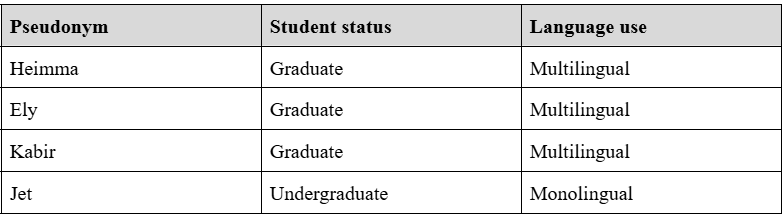
We began our inquiry by recruiting participants. We emailed students who had previously had Written Feedback appointments because we wanted to interact with students who were familiar with the writing center context. We had four students agree to participate in our research, three multilingual graduate students and one monolingual non-traditionally aged undergraduate student:
Because we were interested in learning about participants’ reactions to three different types of Written Feedback instruction, our study included three different phases. In each phase, each participant submitted an approximately six-page draft of their writing and responded to a submission form. This submission form requested background information on the draft–genre, deadline, length–and also included check-boxes where students could indicate what types of feedback they would like to receive–organization, clarity, grammar etc. The research team provided feedback on that draft to the participant–each phase in a different style. During the first phase, we gave participants a global comment and marginal comments, which is our typical Written Feedback style. During the second phase, we gave participants edits in the form of track changes and marginal comments. In the final phase, we offered participants only marginal comments. At the end of each phase, we hosted a focus group so that we could discuss the participants’ reactions to the feedback. In using focus groups as our method, following the work of many scholars in the field (Levin; Fladd et. al.; Suhr-Sytsma and Brown, etc.), we were inspired by calls to use rigorous assessment methods in Writing Center Studies (Lerner) that can be replicated (Hall and Ryan). The focus groups were 30-40 minutes in length and conducted on Zoom. The limited number of participants in our study allowed us to engage in this iterative research–meeting with each participant three times and giving each participant feedback on three drafts.
Although three of our participants were multilingual writers, we do not see this study as focusing on the particular needs of multilingual writers insofar as our questions were related to concepts that are relevant across different language backgrounds. Although editing has been identified as a practice that might particularly benefit multilingual writers because of the desire to acknowledge multilingual writers’ need to adhere to standard academic English norms (Kyle), our study does not focus on the relationship between editing and multilingualism. Instead, we think about how the experience of our multilingual participants might help us develop writing center pedagogy at large by centering the experience of multilingual writers.
Methodology
We chose focus groups as our methodology because we wanted to learn about participants’ reactions to a variety of types of Written Feedback over the course of one semester. Following guidance from Richard Krueger and Mary Anne Casey, we designed our focus groups to maximize participant comfort so that the students participating in it would be encouraged to share their perceptions. We showed respect for each student’s individual contributions by asking open-ended questions and making space for each participant to answer each question. By constructing the environment of each focus group carefully, we fostered trust and our participants were often frank and unreserved. Each session was recorded and was automatically transcribed by Zoom. Then we reviewed each video manually, making corrections to the automatic transcription, adding clarification when participants responded nonverbally (e.g., if a participant wrote in the chat), and inserting annotations that clarified who was speaking.
Coding
We initially read through the transcripts, each independently generating a list of topics that they covered. From there, we met to consolidate our codes by grouping these initial topics into broader codes that could be more widely applicable in the transcripts. In accordance with structural coding principles (Saldaña 68), these codes were related to our research questions and intended to help us determine how our participants would answer these questions. We came up with two levels of codes in our analysis. The first listed our broad areas of interest related to our research questions and the second reflected the different types of responses that emerged under the broad category.
During our focus group sessions, though we had questions prepared, we often followed-up on ideas that participants seemed interested in, replicating a more free flowing conversation. This approach produced digressions in participant responses, which prompted us to code selectively with a focus on our research interests. Using NVivo, we first coded the transcripts independently but could not arrive at a satisfactory coder reliability score, in part because our material was open to interpretation, because of the length of the utterances that we were analyzing and because of the large number of codes we were using. In order to come to consensus, following Harry et. al., we used a collaborative coding resolution process in which we discussed any differences in opinion that we had after coding independently and then came to an agreement about how to apply the codes (6).
After this initial coding process, we looked for patterns in the data and categorized it according to themes (Saldaña 120), which we have noted in our results section.
Limitations
Our research must be understood in relation to certain limitations. We had a relatively small number of participants and none of them were traditionally-aged undergraduate students. This may have influenced how the participants interpreted the feedback and how comfortable they were in rejecting the feedback based on their own expertise. Additionally, the researchers both gave the feedback and facilitated the focus groups, which may have shaped how participants expressed their responses to the feedback. Because we wanted to give context for our feedback, all of our feedback styles included marginal comments. For this reason, participants’ comments about track changes in our second phase of feedback may be colored by the marginal comments that were also present in their drafts. A future study that focused on traditionally aged-undergraduate students, included more participants, offered feedback from anonymous tutors, and provided track changes without marginal comments, would act as a valuable supplement to this study.
Results
After our coding process concluded, we were able to see how often each code was invoked. Since our coding method prioritized capturing only the most prominent idea in each participant’s utterance, however, our approach focuses on analyzing the prevailing themes that we discovered through the coding process rather than focusing on the numerical information associated with how often each code was used. We analyzed our data focusing on how four individuals experienced the feedback that we gave them during the study and, in general, experienced Written Feedback at our institution. Analyzing the data from this vantage point, we were intrigued by a variety of comments that students made about their experiences, which we have categorized in this section.
Global Comments
We found that our participants had a mix of reactions to the global comments that they received. On the positive side, the participants said that the comments were important for helping them develop future drafts, that it organized the feedback they were receiving, and that it reduced their anxiety. On the negative side, participants mentioned that the feedback sometimes did not feel personalized because it followed a template and that it was harder to edit from compared to marginal comments and track changes.
For Heimma, the global comment was mostly positive. In a response about the the editing feedback style, Heimma said,
I'm going to admit that I missed the global comment section. For me, it was more of an organizational aspect where I can read it, and then I can bring my brain to a mindset where, “OK, this is the structure of the feedback. I'm going to go, like, as slow as I can so that I incorporate as much change to improve my draft as I can.”
From Heimma’s perspective, the global comment helped both to organize the feedback on her draft as well as manage some of the overwhelm of attending to a lot of feedback.
She also identified how the global comment helped her to build her writing skills. In our first focus group session, Ely was curious about how she could go beyond editing her draft based on the feedback and instead begin to apply the writing skills mentioned in the feedback across several drafts. Heimma explained to her the way in which the global comment was an effective tool for learning because it categorizes larger issues in the draft and names writing skills that can be transferred to new drafts. Heimma also expressed that the other styles of feedback worked with global feedback to facilitate learning:
The global ones like I said earlier like they help. I mean they helped me organize my brain as to how to process the other marginal ones, because I see if I see a lot of marginal ones, I would be like, oh my god, what is this? So they are all falling into, under one or two categories in global ones. They complement each other.
Heimma’s perspective on global feedback made it clear that the different types of feedback acted cumulatively to produce a positive learning experience.
Despite Heimma’s perspective, not all of the participants found the global comment as helpful as some of the other styles. Because the global comment organizes the feedback, it does not always explicitly say where or what changes should be made. For this reason, it can be more difficult for students to implement the comments. This is exemplified by Jet’s reaction:
Yeah, it doesn't really help me that much. I mean, I still prefer it over nothing, but, you know, I've gotten… I've submitted, like, very big like seven or six page papers and gotten these global comments that weren't very helpful. And I needed to have a paper in like within a couple of days and it just felt like it was almost like wasting my time almost. I really just want, like, specific comments on the writing itself. So the global comments aren't exactly helpful for me.
Here, Jet references his general experience with our writing center. Since his primary goal is to revise his draft, he is less interested in overall comments about his work and instead prefers specific comments or edits that can facilitate the revision process. In contrast with Heimma, Jet was firm that he “never really enjoyed the global comments.”
Marginal Comments
Reactions to marginal comments leaned more towards the positive. For some, the marginal suggestions on their drafts seemed collaborative, some reported that the comments facilitated their learning, some felt like the comments were able to give more details than other types of feedback, and one participant mentioned that the comments gave specific directives. Participants reported feeling like the marginal comments were less overwhelming than track changes. One participant felt like the comments helped them to write in a “native” way. On a more negative note, participants observed that that marginal comments were harder to edit from than track changes and that the comments could be overwhelming if there were too many on a draft.
Ely, in particular, found that when marginal comments used questions, the tone of the feedback was pleasant. Referring to the questions in Lisa’s marginal comments, Ely said:
It's great you asked me questions: “Can you define what you mean? Can you do that?” So the tones of your comments, I think, that matters. I mean, compared to “I don't understand what you're talking about. What the term means?” I mean it's just language that you use when you edit that sounds friendly. It's the reviewers, I mean general reviewers, they are more mean. They are far meaner than you. Just, “I don't understand what you’re talking about.” I think that sounds so harsh.
Although Ely found that marginal comments–especially those phrased as questions–were generally kind, Heimma had a different reaction. She explained, “My personality is, like, I will get terrified if I'll just see the marginal [comments].” For Heimma, seeing only marginal comments without the preamble of the global comment inspired anxiety.
When asked specifically about their most preferred form of feedback, most participants selected marginal comments. Heimma, Ely, and Jet said that marginal comments helped them learn the best, and Kabir thought that both the marginal and global comments, together, helped him learn the best. Jet noted that the marginal comments were precise and localized: “If I were to compare [the marginal comments] to the global comments, I would much prefer [the marginal comments] because they're specific.” Heimma agreed, mentioning, “I also liked the fact that there are more details in those comments.” Other participants thought that the marginal comments were a little easier to process and less overwhelming than track changes. Kabir explained, “with track changes just there were so many things to process at one point. This felt less heavy in terms of reading through it.” Participants’ comments suggested that this is in part because of the presentation of track changes on the screen compared to marginal comments. It is fairly intuitive to use Microsoft Word’s “comments” feature (which we were using to give this kind of feedback) as compared to Microsoft Word’s “track changes” feature because of the many settings associated with track changes.
Track Changes
Collectively taken, our participants presented a nuanced view of track changes. Some participants reported that track changes were collaborative, that they were concise, easy to revise, represented their audience’s response, helpful for novice writers, most useful in the final stage of drafting–similar to marginal comments, and that they captured their meaning. Some participants also said that they were comfortable with the modality. Despite these positive reactions, participants were able to point out a few ways that the track changes were not as useful. In particular, they said that there were some challenges related to how the edits appeared visually in the draft and that they were not as collaborative as other styles.
Compared to global comments and marginal comments, track changes as a style of feedback may seem more directive, since the tutor actively edits the writing. However the discussions with our participants revealed a more complex picture. Although we typically think about written feedback as a style that is unidirectional, Ely saw the presence of edits as collaborative, stating:
I think I see it as a collaboration. I mean it's, indeed overwhelming especially if there are lots of edits there and tracks, but I know the intention is good, so I need time to go through them. So it's more friendly than an anonymous reviewer from [a] journal…so I’m totally fine, with large amounts of edits. That means I have lots of space in need of improving so…
Here, it seems like Ely is thinking about collaboration in concert with the kindness of the tutor. According to Ely, the tutor is someone who has good intentions and wants to help her strengthen the draft. These assumptions about the kindness of the tutor allow Ely to feel as though the edits are not dogmatic, but instead are suggestions that invite her into the process of revision.
We also learned that students were able to use their own judgement when revising a draft with track changes. Jet, for example, explained, “I know you're not standing there with, like, a taser like you're gonna tase me if I don't take all your edits into account.” Students, therefore, are capable of reading edits as suggestions. Both Ely and Jet say they integrate 90% of our comments, which, one might argue, assigns authority to the tutor and makes the feedback directive, but they also communicate their ability to recognize some feedback as irrelevant or incorrect. Heimma, however, felt the need for a better understanding of why we had made some edits, observing that it was difficult to “work with…the track changes without communicating one on one with you guys” because we had suggested a track change that was counter to her disciplinary knowledge. For this reason, she felt as though this style was not as collaborative as she would like.
Track changes also came across as having important affordances to facilitate communication and learning. When students were able to see the revision that was being made (instead of reading a description of what could be changed), the edits helped them see for themselves that the change improved the draft. Kabir explained that for him, “actually seeing [transitions] being edited in the document made, made it, like, made [him] read the document and feel the difference in how the change in this transitional word can actually improve.”
One Student’s perception of the submission form as an administrative task
Although we train tutors to prioritize what students include in their responses to the Written Feedback submission form, we learned that students do not universally see the form as a way of communicating their needs with tutors. We found that one participant perceived it as an administrative task–one that was necessary to complete in order to schedule their appointment–rather than a tool for explaining the context for their draft or conveying the kinds of feedback that they would find most helpful. Jet explained that instead of using the form to communicate, he was emailing tutors directly to convey his preferred feedback style despite the fact that the submission form specifically asks if there is a specific type or style of feedback that students would like to receive. Perhaps in part because we ask tutors to take their own opinions into account when giving students feedback on their drafts, which means that we encourage them to prioritize concerns other than the ones students check on the form if they feel the draft needs improvement in a different area, Jet found that he could not necessarily make a connection between his choices on the submission form and the foci of his tutors. It seems that this may have contributed to his indifferent opinion of the submission form, and led him to circumvent our usual communication methods by emailing his tutor.
Students’ non-linear interactions with the feedback
Throughout the focus group discussions, participants described a range of different processes of engaging with feedback. For example, Heimma explained that she did not take in our feedback all at once. Instead, she read the feedback in a few different sessions. Commenting on her revision process, Heimma said:
So when I received feedback I usually read it first, and then I just go away from it because sometimes I have this internal fear that I did a bad job like those comments, and they were not like they were not telling you you did a bad job or anything. It's just me, like having that internal resistance against, right, and just trying to make an excuse for it. So I just read it once, stay away from it for half a day, and then I come back to it…So what I do is just like I jump, I don't deal with those, and then I try to come back to them later.
She explains that fear that she “did a bad job” is partially responsible for how she deals with feedback, even when the comments are not negative. Processing feedback over a longer period of time helps her to deal with these concerns. She also explains that she does not address each revision area linearly. Instead, she “jumps” from one comment to the next when she is not exactly sure how to incorporate the revision that the comment recommends.
Jet explained that he read the global comment “as quickly as possible” because “there's a lot of stuff in there.” He noted that he wanted to “read [his] own work” because he’s “a little…selfish.” In other words, he skimmed over the global comment and started to read the marginal comments on his work because he wanted to read his own writing.
Kabir described another type of entanglement with the global and marginal comments. He said that he “read[s] the global feedback first,” then he reads through the sentences that were highlighted by the tutor in his draft, and then he reads through the marginal comments.
This non-linear approach to receiving feedback may mimic the way that tutors give feedback, since they are trained to leave marginal comments first and then go back to the beginning of the draft to write a global comment that introduces their feedback.
Students’ tonal preferences in Written Feedback
We also observed differences in the tone that students wanted their tutor to take. While many of the participants valued a kind and friendly voice, Jet explicitly stated that he wanted feedback that was not gentle, explaining:
I was asking people [at the Writing Center] if they would give me more aggressive feedback and finally [Writing Center tutor] is the one that, like, stepped forward and tried it with me, and I remember her being, like, a little worried at first. She was like, “this isn't too, much is it?” And I was like, “No, this is perfect, like, keep doing this.”
From our conversations with Jet, it seemed as though he wanted writing center tutors to be harsh critics of his work, noting all areas where they thought revision could be helpful in a tone that was blunt and straightforward, which contrasts with Ely’s appreciation of the “friendliness” of tutor comments and the fear associated with receiving feedback which Heimma notes above.
Students’ preferences for style of Written Feedback depend on the writing stage
Participants also explained that their preference for a given style of feedback was dependent on contextual factors. Heimma said that track changes are helpful when a draft is in its final stages, but are not as useful before this. Ely agreed with this point of view, noting that, “At a later stage of my dissertation I definitely want the edits [track changes], [to] make it quick to read it, make it more readable, but maybe at the first stage I have some more time and energy. Then I can accommodate…the [marginal] comments and see how I can improve by myself.” Participants’ needs changed as their stage in the writing process changed–the needs were not static throughout the writing process.
Students feeling respected by their Written Feedback tutors
Finally, we learned that participants felt respected even when we made changes to their draft. We asked all of the participants which style felt the most like the tutor was respecting their voice and their ideas. Even though the editing style which used track changes meant that tutors changed their words without consulting the students about it, all of the participants said that they felt equally respected in all three styles. Jet noted that he felt most respected when he was “being taken seriously” even in cases where the tutor “disagree[d]” with him because this signaled a sincere engagement with his work. Although we might have assumed that a kind tone would show respect, Jet and the other participants suggested that respect was conveyed more through genuine engagement rather than a particular tone. Tempering this feedback to a small extent, Ely noted that she thought “all the three styles respect[ed] [her] ideas because [we] didn't change the core elements of what [she was] going to say.” So, it’s fair to assume that if we had engaged with her work in a way that was completely counter to her intentions, she might not have found the advice so respectful.
Discussion
Rethinking the importance of the submission form
There are only one-way interactions in one-time Written Feedback instruction, with the tutor uploading feedback and the student providing some context for the draft through the submission form. Even though the submission form is intended as a means through which students might communicate their feedback needs to the tutor, we learned through these focus group sessions that students did not necessarily view the submission form as a means of communication. However, listening to Jet’s perspective on communication between student and tutor revealed that the lack of opportunity for communication is not necessarily a disadvantage with Written Feedback. When we asked Jet if it was possible for a tutor to know enough about the draft and the context to make changes to the draft through track changes he said, “No, I don't think it's possible, but I don't think it has to be possible. I think there's a lot of value just in hearing somebody else's opinion, and as somebody that's getting the draft.” Jet was interested in receiving feedback that approximated a response from a reader encountering his draft without the context that we might seek as writing center tutors.
Complexity in generalizing students’ reactions
Jet’s unique perspective on Written Feedback contributed greatly to our realization that it was difficult to come up with general principles about how any student might react to a type of feedback. We learnt that this response is shaped by the student’s personality, the affect that writing produced for them, their experience with writing, the kinds of feedback they have received in the past, and the stage in their writing process at which they were seeking feedback, to name a few.
Rethinking our assumptions
There were many ways that what we heard during these three focus group sessions surprised us, making us conscious of certain assumptions we had about students and their response to feedback. First, we realized that we had imagined the student as taking in all of the feedback together in one reading, but each of our participants had a different way in which they absorbed the feedback. Second, we had assumed that kind and collaborative feedback would always acknowledge the student’s agency as a writer and thereby facilitate learning, and this was true to a certain extent–our participants valued our “friendly” tone. Jet, however, requested “harsh” feedback and saw this kind of feedback as representing a kind of care, attention, and interest in his work on the part of the tutor. The other participants, too, showed the capacity to independently place the tutor’s feedback in context.
Practical Application: Writing centers should identify multiple ways of giving feedback
Because we cannot predict what kind of feedback is going to work best for students, we recommend that tutors provide feedback in multiple ways as a standard practice for most drafts. This might look like tutors providing a global comment, marginal comments, and track changes for every draft unless a student requests otherwise. This differs from how our tutors are currently trained to respond with just a global comment and marginal comments. Giving feedback in a wider variety of modalities will allow students to receive the kind of feedback that works best for their learning style, their discipline, and the stage that the draft is in.
This recommendation is also important because we cannot expect all students to understand the terminology that we use at our writing center to describe various kinds of feedback styles. In our focus groups, we defined the terms that we used to describe the feedback style and then provided feedback in that mode. The participants also had the opportunity to ask for clarification. Without this kind of education, however, we cannot expect students (who may be coming to our writing center for the first time) to associate the term with a certain style of feedback. Providing feedback in multiple styles obviates the need for students to have this knowledge or communicate their preferences. Of course, if a student comes to a writing center multiple times throughout a semester and learns what styles work best for them, and what we call these styles, they should be allowed the opportunity to ask for one type of feedback. But, we should not expect this level of knowledge and communication skills from all students.
These recommendations are in alignment with Universal Design for Learning principles, which prioritize flexibility and giving students options for accessing, perceiving, and interacting with educational content and spaces (CAST). A number of scholars in Writing Center Studies have connected UDL principles with writing center work (Dolmage; Cecil-Lemkin and Johnson, Kiedaish and Dinitz; Sharifa, et. al.; Hitt; Kleinfeld; Rinaldi). Following these forays, our findings confirm that UDL principles allow for a variety of students to benefit from writing center teaching. Although none of our participants identified themselves as disabled (and we did not ask them to disclose this information), our study shows how UDL is truly universal–benefitting disabled and non-disabled students alike because it prioritizes offering options and allowing students to learn from the style of feedback that is most in alignment with their learning needs and personal preferences.
We proposed this solution to our study participants and they agreed that they would like feedback on their drafts in a variety of styles. Jet explicitly said that he would “take ‘more is more’ any day.” Ely agreed, explaining that “global, marginal, and in-line comments” would “help [her] a lot.” Heimma concurred saying that she preferred the global comment, plus the marginal edits, plus the marginal comments. Finally, Kabir’s opinions coincided with the other participants during the last focus group discussion once he had received feedback in the three different styles. He said, “I learned from feedback in a particular style, but I also learned about my overall writing combining the message coming out of these three styles.” Although this approach necessitates training tutors about how to provide feedback in a variety of styles, we believe that it will maximize student learning and align with UDL principles. If a draft includes multiple kinds of feedback, students will be able to learn from the style or style(s) that most aligns with preferences and learning needs.
Importantly, our research shows that participants are able to learn from track changes, and sometimes prefer this style. Although there is a fear in writing center circles that track changes are solely directive and dogmatic, our research finds that this is not necessarily how students engage with editing. Instead, they are able to critically evaluate the edits and decide whether they will incorporate the change into their writing. They did not cede their agency to the tutor and did not assume that the tutor was correct about the change that should be made when it was counter to their purpose or convention in the draft’s discipline. While track changes would not be the best form of feedback in all cases–for example, it would be challenging to use track changes to suggest that a structural change needed to be made in a draft–they can convey helpful information (for example: sentence level changes), and should not be eschewed because of a misplaced view that students will not engage meaningfully with track changes.
Conclusions
The most important takeaway from this study was that even among our four participants, preferences for feedback style varied greatly, making it clear that it may be unhelpful to make any assumptions about what a given student might be looking for. Instead, a principle that might guide asynchronous instruction is an effort to provide a variety of feedback styles, which while providing the necessary feedback for that particular draft may serve to begin a learning process about communicating feedback style preferences for the student. The participants in this study also made us question key assumptions that have till now shaped our writing center’s approach to Written Feedback. Despite the comparative lack of space in the Written Feedback modality for conversation and contextualization, all of our participants felt that they were respected as writers through all of our different feedback styles.
Overall, our research opens up exciting possibilities for the future of asynchronous instruction, showing the dialogic possibilities of this form of instruction even in the case where track changes are used. In talking to the students behind the drafts, we were able to ascertain the complex ways that students respond to and digest tutors’ feedback. Students are not passive recipients of tutors’ advice. Instead, they are fully agential and are able to rely on their own disciplinary expertise in order to determine how to respond to the feedback. Our study also makes the case for giving students options for how they are receiving feedback in alignment with UDL principles since our four participants were not able to reach consensus about what kinds of feedback best facilitated their learning. Taken together, these findings suggest that asynchronous instruction–when designed with flexibility and student choice in mind–can support meaningful dialogue, student agency, and inclusive learning across diverse writing contexts.
Works Cited
Adepoju, Olalekan T. “Discursive Practices in Recurring Asynchronous Writing Center Consultations." The Writing Center Journal, vol. 42, no. 3, 2024, pp. 1-25. https://doi.org/10.7771/2832-9414.1018.
Angelov, Dimitar, and Lisa Ganobcsik-Williams. “Singular Asynchronous Writing Tutorials: A Pedagogy of Text-Bound Dialogue.” Learning and Teaching Writing Online, Brill, 2015, pp. 46–64. brill.com, https://doi.org/10.1163/9789004290846_005.
Blau, Susan, and John Hall. “Guilt-free tutoring: Rethinking How we Tutor Non-Native English-Speaking Students.” Writing Center Journal, vol. 23, no. 1, pp. 23–44. https://doi.org/10.7771/2832-9414.1553.
Breuch, Lee-Ann M. Kastman, and Sam J. Racine. “Developing Sound Tutor Training for Online Writing Centers: Creating Productive Peer Reviewers.” Computers and Composition, vol. 17, 2000, pp. 245-263. https://doi.org/10.1016/S8755-4615(00)00034-7
Brooks, Shannon McClellan. “Centerless? Making Sense of Disruptions in the Graduate Writing Center.” The Writing Center Journal, vol. 42, no. 1, 2024, pp. 85-106. https://doi.org/10.7771/2832-9414.2053
Buck, Courtney, et al. “‘I Believe This is What You Were Trying to Get Across Here’: The Effectiveness of Asynchronous eTutoring Comments.” Praxis: A Writing Center Journal, vol. 18, no. 2, 2021, https://www.praxisuwc.com/182-buck-et-al.
Castner, Joanna. “The Asynchronous, Online Writing Session: A Two-Way Stab in the Dark?" Taking Flight with OWLs: Examining Electronic Writing Center Work, edited by James A. Inman and Donna N. Swell, Lawrence Erlbaum Associates, 2000, pp. 121-130.
Cecil-Lemkin, Ellen and Lisa Marvel Johnson. “Developing a Multimodal Toolkit for Greater Writing Center Accessibility.” Another Word, University of Wisconsin at Madison, https://dept.writing.wisc.edu/blog/multimodaltoolkit. Accessed 1 November 2024.
Coogan, David. “E-mail Tutoring, a New Way to Do New Work.” Computers and Composition, vol. 12, 1995, pp. 171-181. https://doi.org/10.1016/8755-4615(95)90005-5
Daniels, Sharifa, et al. “Writing Centers and Disability: Enabling Writers through an Inclusive Philosophy.” Praxis: A Writing Center Journal, vol. 13, no. 1, 2015, http://www.praxisuwc.com/daniels-et-al-131.
De Herder, William. “Composing the Center: History, Networks, Design, and Writing Center Work.” Praxis: A Writing Center Journal, vol. 15, no. 3, 2018, pp. 6-22. https://repositories.lib.utexas.edu/server/api/core/bitstreams/f06f7784-1c47-4e4c-97d3-04dbe02964a5/content.
Dolmage, Jay. “Universal Design: Places to Start.” Disabilities Studies Quarterly, vol. 25, no. 2, 2015, https://dsq-sds.org/index.php/dsq/article/view/4632/3946.
Eckstein, Grant. “Grammar Correction in the Writing Centre: Expectations and Experiences of Monolingual and Multilingual Writers.” The Canadian Modern Language Review / La revue canadienne des langues vivantes, vol. 72 no. 3, 2016, pp. 360-382. Project MUSE, https://muse.jhu.edu/article/629370.
Fladd, Nadine, et al. “Evaluating the Effectiveness of Dissertation Boot Camp Delivery Models.” Writing Center Journal, vol. 37, no. 2, Jan. 2019. DOI.org (Crossref), https://doi.org/10.7771/2832-9414.1881.
Hall, Susanne and Holly Ryan. “The Neglected ‘R’: Replicability, Replication, and Writing Center Research.” Writing Center Journal vol. 39, no. 1, 2021, https://doi.org/10.7771/2832-9414.1964.
Harry, Beth, et. al. “Mapping the Process: An Exemplar of Process and Challenge in Grounded Theory Analysis.” Educational Researcher, vol. 34, no. 2, 2005, pp. 3-13. https://doi.org/10.3102/0013189X034002003.
Hawthrone, Joan. “‘We Don’t Proofread Here’: Re-visioning the Writing Center to Better Meet Student Needs.” The Writing Lab Newsletter vol. 23, no. 8, 1999, pp. 1-7. https://wac.colostate.edu/docs/wln/v23/23.8.pdf.
Hedengren, Mary, and Martin Lockerd. “Tell Me What You Really Think: Lessons from Negative Student Feedback.” The Writing Center Journal, vol. 36, no. 1, 2017, pp. 131- 45. https://doi.org/10.7771/2832-9414.1817
Hewett, Beth L. The Online Writing Conference: a Guide for Teachers and Tutors. Portsmouth, NH: Boynton/Cook, 2010.
Hitt, Allison. “Access for All: The Role of Dis/Ability in Multiliteracy Centers.” Praxis: A Writing Center Journal, vol. 9, no. 2, 2012, http://www.praxisuwc.com/hitt-92
Hutton, Lizzie, et al. “Asynchronous and Rhetorical: Appointment Forms and Their Effect on Writer-Consultant Exchanges.” The Writing Center Journal, vol. 41, no. 3, 2023, pp. 55–71. https://doi.org/10.7771/2832-9414.1036
Kiedaisch, Jean, and Sue Dinitz. “Changing Notions of Difference in the Writing Center: The Possibilities of Universal Design.” The Writing Center Journal, vol. 27, no. 2, 2007, pp. 39–59. https://doi.org/10.7771/2832-9414.1630
Kleinfield, Elizabeth. “Taking an Expansive View of Accessibility: The Writing Center at Metropolitan State University of Denver.” Composition Forum, vol. 39, 2018, http://compositionforum.com/issue/39/msu-denver.php.
Krueger, Richard A., and Casey, Mary Anne. Focus Groups: A Practical Guide for Applied Research. 5th ed., SAGE Publications, 2014.
Kyle, Barbara Rau. “Merging Tutoring and Editing in a Chinese Graduate Writing Center.” Praxis: A Writing Center Journal, vol. 15, no. 3, 2018. https://www.praxisuwc.com/153-kyle.
Lerner, Neal. “Writing Center Assessment: Searching for the ‘Proof’ of Our Effectiveness.” The Center Will Hold, edited by Michael Pemberton, Utah State University Press, 2003, pp. 58-73. https://muse.jhu.edu/pub/187/oa_monograph/chapter/201911.
Levin, Katie et. al. “‘Was it useful? Like, really?’: Client and Consultant Perceptions of Post-Session Satisfaction Surveys.” Writing Center Journal vol. 39, no. 1, 2021, https://doi.org/10.7771/2832-9414.1967.
Raforth, Ben. "Why Visit Your Campus Writing Center." Writing Spaces: Reading on Writing, Volume 1, edited by Charles Lowe and Pavel Zemliansky, Parlor Press, The WAC Clearinghouse, 2010, pp. 146-155. https://wac.colostate.edu/books/writingspaces/writingspaces1.
Rambiritch, Avasha, and Adelia Carstens. “Good Feedback Practices Related to Asynchronous Online Writing Support in a Writing Center.” International Journal of Literacies, vol. 29, no. 1, Jun. 2022, pp. 27–42. https://doi.org/10.18848/2327-0136/CGP/v29i01/26-41
Rinaldi, Kerri. “Disability in the Writing Center: A New Approach (That’s Not so New).” Praxis: A Writing Center Journal, vol. 13, no. 1, 2015, http://www.praxisuwc.com/rinaldi-131.
Saldaña, Johnny. Coding Manual for Qualitative Researchers. SAGE Publications, 2009. ProQuest Ebook Central, https://ebookcentral.proquest.com/lib/wisc/detail.action?docID=585421.
Suhr-Sytsma, Mandy, and Shan-Estelle Brown. “Theory In/To Practice: Addressing the Everyday Language of Oppression in the Writing Center.” Writing Center Journal, vol. 31, no. 2, Jan. 2011. https://doi.org/10.7771/2832-9414.1732.
Thompson, Isabelle, et. al. “Examining Our Lore: A Survey of Students’ and Tutors’ Satisfaction with Writing Center Conferences.” Writing Center Journal, vol. 29, no. 1, Spring 2009, pp 78-105. https://doi.org/10.7771/2832-9414.1672.