Praxis: A Writing Center Journal • Vol. 23, No. 3 (2026)
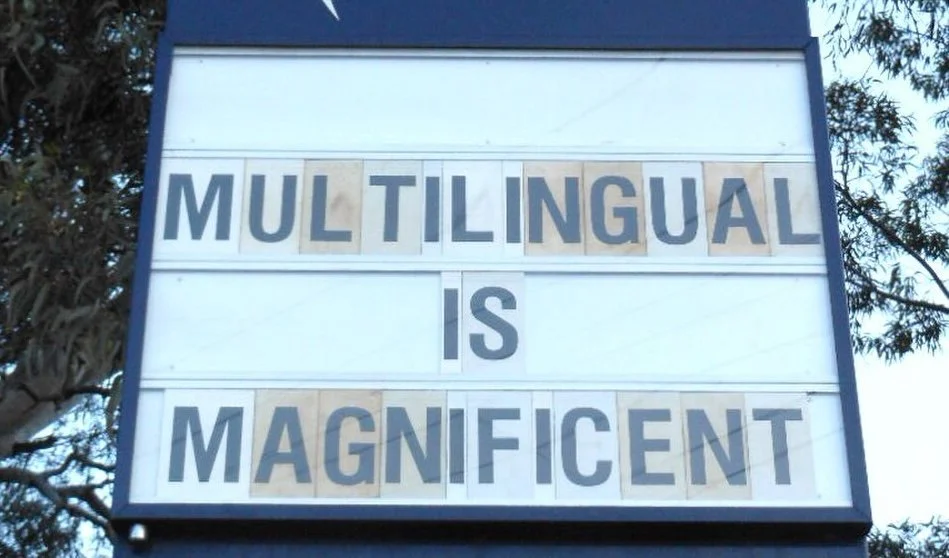
Sign outside Australian language school. Image: Michael Coghlan, Wikimedia Commons.
Tutors’ Flexible Approach in Working with Multilingual Writers
Emily Jane Pucker
Georgia College & State University
emily.pucker@gcsu.edu
Abstract
Why do writing center professionals, many of whom are not required to engage in scholarship, opt to go through the laborious process of publication? And what factors might facilitate or inhibit the publication process for authors in the discipline? To help answer these questions, we conducted a mixed-methods IRB-approved study consisting of a web-based survey (N=58) and follow-up virtual interviews with six writing center practitioners. We illustrate in this article a framework, grounded in quantitative and qualitative data, for fostering more inclusive practices for welcoming voices into published writing center spaces. We also provide insight into how publishing fosters writing center scholars’ positionality within a discipline and the extent to which the peer review process informs (and complicates) why writing center practitioners do or do not publish in the field.
The contemporary writing center is built to serve traditional students well, but as the university diversifies, so does the writing center. Increasing numbers of multilingual writers are entering the university and using the writing center.. What do tutors do to meet the needs of the writers they serve? Using first-person interviews with tutors in a large and successful center, the author finds that flexible tutoring is the key to supporting multilingual writers. Each tutor interviewed claimed to value primarily “non-directive” methods of tutoring, but quickly revealed a willingness to adjust that approach according to the needs of the writers. Flexibility, including the ability to engage in more directive practices, was at the core of successful tutoring multilingual writers.
Keywords: writing centers, tutoring, multilingual writers, flexibility
Introduction
In 2016, while working as a new doctoral student in the writing center at the University of Alabama, I began to notice a pattern: tutors trained in non-directive methods often shifted their approach when working with multilingual writers. Despite their formal preparation, tutors frequently adopted directive strategies, such as offering grammatical guidance, suggesting structural changes, or even writing directly on students’ papers, when they sensed that doing so would better support the writer’s needs. This observation led me to a central question: How do writing tutors negotiate tensions between their training and the realities of working with multilingual writers?
Writing center pedagogy has long emphasized the non-directive approach. Under this paradigm, the writer retains control over their work and the tutor prioritizes the agenda articulated by the writer. However, this practice assumes that writing center clients are able to identify areas of concern in their writing; that they can articulate their concerns in English; and that they feel empowered to make requests of someone they interpret as an authority. Taking these factors into consideration, recent scholarship has begun to question whether non-directive methods adequately serve linguistically diverse students (e.g., Salem; Moussu; Thonus). Scholars have begun to look at how tutors adapt their practices when working with ESL students and what those adaptations reveal about the evolving role of the writing center. For example, Beth A. Towle (2023) investigated how first-generation college students experience the writing center differently than peers more familiar with academic norms. Towle found that first-gen students often feel like “outsiders” to the academy. Tetyana Bychkovska and Susan Lawrence (2024) used surveys to reveal that tutors typically provide more sentence-level assistance to multilingual writers. As Moussu writes, “Regrettably, this tutoring philosophy [has] unintended consequences: ESL students who go to WCs in hopes of finding help with a difficult language and who specifically need feedback on what WC culture tends to regard lower-order concerns may feel structurally excluded” (59). Faced with clients with distinct needs, the participating tutors in these studies are breaking from the traditional expectations in writing center work in order to prioritize their clients.
Using interviews and case studies from a large, research-intensive university in the American South, this study seeks to understand how tutors adapt to the needs of non-traditional clients. In the academic year this study began (2019-2020), 3.8% of the university’s student population was international students (The University of Alabama). This number is in line with comparable institutions: the 2025-2026 year saw 3% international students at the nearby University of Mississippi (University of Mississippi) and 6% international students at the University of Georgia (University of Georgia). These numbers are likely to climb in future years: according to the Institute of International Education, “As of the 2024/25 academic year, the United States hosted nearly 1.2 million international students, reflecting a 5% increase from the previous academic year” (2026). Thus, the findings of this study can be extrapolated to shed light on practices at other institutions and to prepare for an increasingly internationalized future. The study examines how tutors describe their training, how they reflect on their actual tutoring sessions, and how they reconcile the gap between the two. My findings suggest that tutors are not simply abandoning their training, but rather reinterpreting it in context—prioritizing student needs over pedagogical orthodoxy. This paper contributes to ongoing conversations about tutor agency, multilingual support, and the future of writing center pedagogy.
Profiles of Tutor Participants
My first task was to understand how tutors view their tutoring practice and how they describe their work. To identify tutor participants, I put out a call via our writing center’s listserv. I also contacted tutors whom I knew personally, including former students. The three tutors who volunteered to be a part of this study paint a picture of the struggle between directive and non-directive practices when working with non-traditional students in the writing center. All tutors in this study worked at the University of Alabama Writing Center during the 2019-2020 academic year. My research was conducted in accordance with The University of Alabama’s human research guidelines, and the names of the participants have been changed.
First, I interviewed Gemma, an undergraduate tutor. Gemma is a white-presenting young woman with a great sense of humor and green hair. Gemma started out as a first-year student in one of my classes; I encouraged her to apply for the tutoring course, a requirement for all undergraduate tutors, and I was her instructor in that class as well. We therefore have a long-standing relationship and rapport. The second tutor I interviewed was Muna, an international graduate student from Turkey by way of the United Kingdom. She speaks English with ease and fluidity, but occasionally mistakes one word for another or loses tracks of her sentences. Nevertheless, her willingness to persevere in an Anglophone country—since our interview she has settled in the Pacific Northwest with her American partner—is admirable. The third tutor was Kristin; at the time of our interview, she was also a graduate student, studying applied linguistics. Despite limited tutoring experience, she was confident and comfortable with multilingual writers and planned a career in teaching.
These three tutors kindly gave of their time to help me understand how they do what they do. While they are, of course, all individuals with unique styles and beliefs about tutoring, they described a variety of similarities. Common themes ran through our conversations, which helped me to gain a clearer picture of the techniques the tutors use with their clients and help them to grow as writers.
Interviews of Tutors
I began each interview with a list of open-ended questions asking tutors to think about what they anticipated happening in a session, and then reflect on what did in fact transpire. Here, I sought information on how the tutors did their work and to what degree their goals aligned with the clients’ expectations. If both the client and tutor agreed that the tutor worked to keep control over the session and the writing stayed in the hands of the writer, we can infer that the session followed the nondirective approach. Muna, for example, described the great effort she puts in to avoid pointing out errors for a client when the Socratic questioning method might help the client discover errors for themselves.
I also interviewed several multilingual writers who used the writing center; while their full responses are beyond this study's scope, their feedback helps measure the effectiveness of the tutors' methods. Having collected the tutors’ and clients’ feedback, I applied the principles of grounded theory to guide my analysis of these interviews.
Grounded Theory
Grounded theory is a way to build a theory “from the ground up,” to allow the data to create and guide the theory, rather than to impose it from the literature (Urquhart). Grounded theory methods (GTM) include systematic coding and data analysis to identify emerging relationships.
I carefully coded the transcripts of my interviews using colored highlighters; however, instead of looking only for common themes or topics from one interview to the next, I sought relationships among those themes. Urquhart writes, “It is almost certain you will find categories that are, in fact, characteristics of others. The relationships ‘Is a kind of’ and ‘Is a characteristic of’ enable researchers to decide which of their codes are, in fact, aspects of others” (chapter 1). Following this advice, I identified these relationship markers within the interviews to guide later analysis. This is to say that my development of a coding system that accurately and effectively analyzes these interviews is part of an iterative process of developing a coding system that is essential to GTM. Ultimately, I found that the tutors expressed similar trajectories of adaptation: they begin with a commitment to non-directive practices, such as avoiding line-editing or providing full phrases to their clients. When faced with multilingual clients, however, the tutors find clients who expect authoritative feedback and reassurance that they are expressing ideas “correctly” (Moussu 60). The tutors in my study responded by using more directive strategies for multilingual writers, which better serve those writers and help them reach their goals.
Directive Strategies in Practice
Each of the tutors who volunteered for the study did so on the basis of their commitment to non-directive tutoring. However, the interviews revealed they are in fact much more open to a flexible tutoring style that takes into consideration the specific needs of their clients. Despite the received wisdom of writing center studies that suggests that non-direction is the best practice, these tutors often see that their clients need different kinds of intervention and help in order to truly develop as writers. In practice, during sessions with multilingual writers, tutors adjust to give more direction to their clients. The tutors gave specific descriptions of the steps they take to support these multilingual writers.
Given that Gemma had studied with me for several years, I expected her responses to reveal a strongly non-directive approach to tutoring. However, actual sessions with actual clients don’t always reflect a tutor’s inclinations. For Gemma, non-directive tutoring seems to mean allowing the client’s stated goals to take precedence in the session. In practice, Gemma may guide the client away from those stated goals if she feels they are not the best use of the client’s time and energy.
Right from the start, Gemma identified a familiar situation in writing center tutorials: a client who desires help with “grammar.” For many clients, especially for undergraduates and those lacking confidence in their writing skills, “grammar” is a catch-all term for many types of concerns, including mechanics, usage, spelling, punctuation, as well as broader concerns with clarity of expression or formatting. Eckstein and Ferris note that even highly proficient L2 writers lack confidence (157). Gemma pointed out that her approach varies depending on the language skills of the client:
If it’s a native speaker who’s coming in [asking], ‘can you just look at my grammar, just like, my APA citations,’ I’m a little bit annoyed because I want to help them build their paper but we were taught like, ‘hey, we’re not a proofreading service.’ [But] I want to be able to interact with [the client] and help them build their paper. So even if they just ask for grammar, I try [to] make sure that the bigger things are in order, as well. If I do see big issues, I’m not going to ignore them [just] because they asked for me to look at grammar.
Her training and experience, as well as her distance from the writing, allows Gemma to identify areas that require attention and care beyond local-level concerns. She strives to honor the client’s stated goals, but she also knows clients are often unaware of what they need to do, exactly, in order to accomplish those goals. Gemma therefore steers the conversation toward global issues when she feels steering is needed. Though this approach deviates from the typical call to let the client determine the goals for the session, Gemma’s method is in keeping with the intention to make better writers.
Graduate student Muna takes a slightly more subtle approach. A multilingual writer herself, Muna was born in Turkey. When asked to describe her tutoring style, Muna said,
I’m definitely not a direct[ive] tutor, pointing out the errors or the issues with what my student has written down. This concerns the students who write in the report, ‘I’m not sure if my content is good,’ or, ‘I'm not sure it flows well,’ all these things. So the whole session shapes around these concerns. I look at them first and then [...] any other things that I kind of notice. My goals are first to eradicate any concerns that the clients have—it might be a flow thing that they’re concerned with—and then I look at it then if there are really issues.
Muna does not see herself as offering direction but allowing the client to set goals, which she prioritizes for their time together; as she says, she seeks to “eradicate” the client’s concerns as the first order of business. She then attempts to subtly guide the client to their own conclusions about their writing. When a tutor asks leading questions about a problem area the client has not noticed, the client is more likely to see the discovery as their own and is therefore more likely to retain the lesson.. For Muna, this is the definition of non-directive tutoring, which is in line with the sentiments of many tutors with whom I communicated: there is value in the act of discovery.
Muna seeks especially to integrate the client’s stated concerns with those she observes as the tutor. As an illustration, she described a client who comes to the writing center seeking help with “flow,” a notoriously elusive quality. The client’s goal is to create smoother-sounding writing, in which one idea moves logically into the next. Naturally, one solution here is to make greater use of transitional words and phrases – but this of course occurs more readily to the tutor than to the client. Muna points out a spot in need of work, then encourages the client to find their own solutions to the problem of flow. She asks if a “linking word” such as “moreover” or “furthermore” might be appropriate, then let the student decide. This thoughtful approach allows the client to set the goals for the session and to identify solutions on their own, while still being guided by the tutor’s experience and ability to view the work from a distance. Muna uses rhetorical questions and indirect suggestions to guide the client toward a conclusion that retains the client’s voice.
The third tutor I spoke with, Kristin, was a graduate student studying applied linguistics at the time of our interview. The previous semester, Kristin co-taught a first-year writing course geared toward multilingual writers,classroom experience that no doubt influences her approach to tutoring, which she describes as “a student-needs focused approach.” Krisin likewise asks clients leading questions to help them draw their own conclusions, yet for her, non-directive tutoring means emphasizing the client’s needs even if this means providing explicit direction. In this way, Kristin’s style contradicts her identification as a non-directive tutor; however, when placed in context with colleagues Gemma and Muna, it becomes clear that tutors are willing to shift and adjust their practices in a session to help the client reach the goal of becoming a better writer. These examples show how tutors implement directive strategies in practice. But what motivates these shifts, and how do tutors justify them? The next section explores the reasoning behind these adaptations.
Adapting Tutoring Methods for Multilingual Writers
The tutors are caring and empathetic toward the clients, and willing to shift their approach to be more directive when needed. This section examines the motivations and contextual factors that lead tutors to adapt their methods. Gemma, for example, stated that,
With non-native speakers, I do try to focus on grammar a lot more because I realize that's what they really do need help with … They didn't spend years in elementary school learning [English] grammar rules, you know? When they come to the writing center saying ‘I need help with grammar’, it’s … not just something [they’ve] put on the appointment form.
Kristin echoed this phenomenon, saying that though she gets requests for grammar help from monolingual writers,
I feel like it’s more prevalent with ESL students, and… they really want you to correct their grammar… In those sessions, I [do] give a little bit more attention to grammar than I would in my other sessions.
The tutors in this study are acting, in part, as linguistic informants who are able to help the writers navigate the challenges posed by lacking an innate understanding of English (Harris and Silva 530). Unlike domestic students who often use “grammar” as a catch-all term for proofreading activities, multilingual writers are intentional about seeking a deeper understanding of their target language.
This tendency to use “grammar” as a catch-all can lead to a mismatch between the client and tutor’s goals for the session. I summarized Gemma’s approach during our conversation as, “When I’m working with a domestic student who says they want to talk about grammar, I feel like it’s going to be a more superficial conversation than if I’m working with a multilingual writer who states they have similar goals.” The tutor is inclined to allow the client to determine the goals of the session, but is likely to override this if the client’s stated goals are not appropriate for the text they are working on; this disconnect is more likely to occur with clients for whom English is their primary language, according to Gemma and others. These real experiences recalled by the tutors are in contrast with recommendations by Moussu and others specifically to prioritize content over form: the tutors in this study are acting, in part, as linguistic informants who are able to help the writers navigate the challenges posed by lacking an innate understanding of English (Harris and Silva 530). The hybrid approach, which blends together the directive and non-directive, accords well with the description by Matsuda and Cox, who identify multiple ways to read multilingual writers’ writing. Zawacki and Habib similarly argue for greater attention to explicit grammar in writing classrooms as a means to unlocking expression. Gemma’s experiences are not unique to her:
In contrast, and for reasons stated above, a multilingual writer who identifies a goal of working on grammar is more likely to in fact desire to work on grammatical structures in writing, and less likely to use the term “grammar” to include tasks that are not grammatical.
Another way tutors adapt to the unique needs of multilingual students is by going beyond the text to consider oral expression. Despite the pandemic preventing in-person sessions, the center continued to offer help over Zoom and not only asynchronously. Since they could talk with the clients live, they could work on oral skills as well as written. For example, Gemma described working with a client from South Korea, who struggles with English pronunciation and American cultural features. The live conversation allowed Gemma to help the client work on skills like “small talk” at the start of an interaction. From these conversations with her client, Gemma took away certain understandings of South Korean culture:
[Small talk] is not really a common thing in South Korean culture, so before we started this interview, we [tried] a little bit of small talk… I noticed as our sessions are progressing, we chit-chat a little bit before we get into the session: ‘How is your day going? How’s that job interview?’ So we practice that a little bit, and then we go into grammar and pronunciation and things like that.
Here, Gemma brings up an oft-overlooked function of the writing center: helping clients to develop academic skills beyond their writing. It matters less whether Gemma gained an accurate understanding of South Korean social norms than that she helped a client develop confidence in conversational English. Tutors may fill the function of academic coach or role model by showing clients they’re allowed to email professors, where to go to access campus resources, or how to use the library. In her work with the client mentioned above, Gemma acts as a writing tutor as well as a speech coach and guide to American cultural expectations. Gemma becomes a “cultural informant” as described by Williams and Severino, explaining to her client how the client’s expectations may not match the realities of academic culture in the U.S.
There are other ways in which the tutors described adapting their practice to better serve these writers. Because Muna is herself a multilingual writer, she talked about the depth of her empathy with these clients: “I know what they're going through and I know that I feel empathetic towards their whole writing in a second language journey.” She feels she is more able to identify potential problem areas for these writers because she shares them. Furthermore, she is highly sensitive to the challenge of mastering the genre of academic essays, a genre that may not exist in the clients’ home countries. Many of “those students come from kind [of] backgrounds where they probably never ever have written anything even in their language,” Muna explained. “I try to be even more gentle.”
It is fair to wonder if these adaptations in fact achieve the goals of the writing center: from the tutor’s perspective, it can be difficult to know how successful a session has been. Clients typically do not provide updates on their work after they leave the center. However, occasionally they may email the tutor to thank them for their feedback; this is especially true of asynchronous appointments, in which the tutor and client interact only through written comments. However, as Gemma pointed out, an important clue to the tutor that their work has been useful to the client is when the client chooses to book another appointment with that tutor for the future. Building a relationship over many sessions is one of the most gratifying parts of writing center work; as Gemma put it,
Seeing the same name pop up on your schedule multiple times kind of gives you a sense of, ‘Okay, I'm helping… They keep coming back to me in particular, so I must be doing something right.’ [With] repeat clients, verbal feedback [is] a sign for me that I’m doing a good job.
Indeed, the experience of seeing a client grow as a writer—and knowing that the client appreciates the tutor’s time and effort, expressing this by becoming a “repeat customer”—may be the highest compliment a tutor can receive.
Kristin built on this idea. She too appreciates the occasional response email she receives, and she identifies returning clients as a sign of success. She also points out that seeing a client actively change their writing in response to the tutorial session is perhaps the greatest indication of success – that is, not only do these clients return to her, but they have worked to incorporate her suggestions and have even gone further to apply her advice elsewhere in the paper: “They’ve gone beyond what I have suggested and really revised their paper and put a lot of thought into it: I think that's a successful session, and I can kind of measure that from paper to paper.” Doubtless the experience of helping a client to grow and develop as a writer over time is a valuable one. Kristin’s past experience as a classroom teacher no doubt also helped her to notice how clients can grow over the course of several visits.
Asynchronous Tutoring
As a result of the global pandemic, many institutions shifted to online instruction. For many writing centers, this included asynchronous tutoring. This means that the client uploads their work as a text file, and the tutor provides written feedback on that text and returns it within a specified timeframe. Asynchronous sessions offer unique opportunities—and challenges—for supporting multilingual writers, particularly in grammar instruction and revision planning. This text-only model has its drawbacks, to be sure, but one of its benefits is the tutor’s ability to provide more thoughtful feedback as they can revise their writing, as opposed to the more immediate responses required by verbal conversation. Especially important for multilingual writers is the ability to more carefully read and digest the tutor’s feedback and refer back to it as they revise. This was a common mechanism for coping with the pressures of the pandemic, and one that has been retained by many institutions. For example, my current institution, Georgia College & State University, offers three modalities for writing help: face-to-face, online through video conferencing, and asynchronously as described above (Georgia College & State University); online programs, such as Southern New Hampshire University, have been using asynchronous tutoring for even longer. Situating these tutors’ experiences alongside those of other writing centers highlights the broader pedagogical shift toward flexible, multilingual-responsive approaches in asynchronous environments.
Gemma, who has extensive online tutoring experience, shared that when she sees a grammar issue, she provides not only instructions for correcting the error, but also the reasoning, in the hope that the client can avoid further instances of that error. When Gemma is confident that she is working with a multilingual writer, she seeks to offer an even more in-depth response to the error. Because of the increased grammatical knowledge many multilingual writers have due to learning English as an academic subject, this further explanation can be especially useful, building on their existing knowledge or reminding them of information they had learned but forgotten.
In much the same way, Muna likes to leave summative feedback on an asynchronous session that gives the multilingual client specific areas to work on. For example, she writes to the client, “Whenever you're revising this by yourself, think about these three things. Just focus on a few things that are manageable to get done before you have to turn this in or before your next session.” This approach gives structure to the client’s next steps without hijacking the writing, and while helping the writer to focus on global concerns while revising. Most of Kristen’s tutoring experience has been online due to the global pandemic. Regarding the kind of advice she offers to her multilingual clients in asynchronous sessions, Kristen said,
I’ve been leaving a lot of comments on their drafts… questions that will guide them [toward] things that will improve the clarity of their draft. I try to make my comments [relate to] things that the students have identified that they think they need work on in their papers.
In short, Kristen’s willingness to offer some explicit direction in an asynchronous session resembles their willingness to do so in an in-person or live video conference session. Writing centers like ours still deal with the changes brought by the Coronavirus pandemic. Some of these changes, such as the embracing of online options, remain after restrictions are lifted. There will be more opportunities to study how tutors and clients do asynchronous tutoring and how asynchronous tutoring affects clients’ learning.
Conclusion
When writing center professionals imagine their clients, they often imagine someone who simply needs a little prodding to produce stronger work. The tutors I interviewed tended to describe their approach as “nondirective” because they see this as prodding a way to avoid handing clients the answers. However, multilingual clients may not be able to articulate their own answers regardless of the amount of prodding from the tutor. Gemma, Muna, and Kristin interviewed knew this intuitively. Despite their commitment to non-directive methodology, each adapt their practice to meet the needs of multilingual writers. The clients, in turn, describe an increased sense of self-efficacy and of capability following an appointment in the center. That is, the clients are getting what they need. Thus, training for tutors must evolve to support tutors in the many ways they will be called upon to make sure their clients are getting what they need.
Works Cited
Babcock, Rebecca and Therese Thonus. Researching the Writing Center: Towards an Evidence-Based Practice. New York: Peter Lang Inc., 2012.
Bychkovska, Tetyana and Susan Lawrence. “Tutors’ Perspectives on Their Work with Multilingual Writers: Changes over Time and in Response to Revisions in Training.” The Writing Center Journal (2024): 76–101.
Cogie, Jane. “ESL Student Participation in Writing Center Sessions.” The Writing Center Journal 26.2 (2006): 48–66. JSTOR. 28 June 2024.
Eckstein, Grant and Dana Ferris. “Comparing L1 and L2 Texts and Writers in First-Year Composition.” TESOL Quarterly 52.1 (2018): 137–62. http://www.jstor.org/stable/44984815.
Georgia College & State University. “Writing Center.” 2026. https://www.gcsu.edu/writingcenter.
Harris, Muriel and Tony Silva. “Tutoring ESL Students: Issues and Options.” College Composition and Communication 44 (1993): 525–537.
Institute of International Education. “International Students.” 2026. https://opendoorsdata.org/annual-release/international-students.
Lerner, Neal. “Writing Center Assessment: Searching for the ‘Proof’ of Our Effectiveness.” The Center Will Hold, edited by Pemberton, Michael K. and Joyce Kinkead. Utah UP, 2003. 584–745.
Matsuda, Paul Kei and Michelle Cox. “Reading and ESL Writer’s Text.” ESL Writers: A Guide for Writing Center Tutors. Edited by Bruce, S. and Ben Rafoth. Boynton/Cook Heinemann, 2009. 42–50.
Moussu, Lucie. “Let’s Talk! ESL Students’ Needs and Writing Centre Philosophy.” TESL Canada Journal 30.2 (2013): 55–68. research.ebsco.com/linkprocessor/plink?id=9e2d46dd-7d51-3b4e-bc27-674fbf14b445.
Salem, Lori. “Decisions…Decisions: Who Chooses to Use the Writing Center?” The Writing Center Journal 35.2 (2016): 147–71. http://www.jstor.org/stable/43824060.
Southern New Hampshire University. “Scholarly Communication and Publishing.” 2026. https://libguides.snhu.edu/scholarly-communication-and-publishing/WritingSupport.
The University of Alabama. “The University of Alabama Higher Education Act Student Population Information Fall 2019.” 2019. https://oira.ua.edu/HEA/reports/general-information/student-population/201940.html.
Towle, Beth. A. “Accidental Outreach and Happenstance Staffing: A Cross-Institutional Study of Writing Center Support of First-Generation College Students.” The Writing Center Journal (2023): 72–86.
University of Georgia. “Admissions.” 2026. https://www.admissions.uga.edu/admissions/admission-statistics.
University of Mississippi. “University of Mississippi International Student Report.” 2026. https://www.collegefactual.com/colleges/university-of-mississippi-main-campus/student-life/international.
Urquhart, Cathy. Grounded Theory for Qualitative Research: A Practical Guide. SAGE, 2013.
Zawacki, Terry Myers and Anna Sophia Habib. “Internationalization, English L2 Writers, and the Writing Classroom: Implications for Teaching and Learning.” College Composition and Communication 65.4 (2014): 650–9. http://www.jstor.org/stable/43490878.