Praxis: A Writing Center Journal • Vol. 23, No. 3 (2026)

Image: Motherboard for Amiga 4000 by Podstawko, WikiCommons.
Paradigm Shifts: How Institutional Logics Reshape Writing Center Work
David Brauer
University of North Georgia, Dahlonega
david.brauer@ung.edu
Abstract
It is a common occurrence in writing center scholarship that a relationship is drawn between the work of writing centers and that of first-year composition programs. Indeed, in the pursuit of helping students develop literacy skills, a certain institutional and disciplinary partnership exists. Even if writing centers and writing programs are not connected directly through organizational structures within an institution, they work together in common cause to improve student writing. But changes in higher education are reshaping the institutional landscape. Institutions are creating policies and initiatives that may place writing centers and writing programs in an adversarial relationship. Institutions now have the power to reshape or even break the connection between these institutional players and undermine their commitment to literacy development. This article explores how and why this shift occurs and how writing center administrators may negotiate this dynamic to develop and maintain institutional capital and to evolve with institutional changes. In analyzing a case study from my own institution, the author applies the institutional logics perspective of Patricia Thornton and John Ocasio. By drawing from institutional theory, this article provides writing center administrators with a novel approach to an emerging tension in institutional contexts and in the discipline.
Keywords: writing center administration; first-year composition; writing program; institutional theory; institutional logics perspective
Introduction
From the early days of modern writing center practice in the 1970s and 1980s, the writing center has aligned itself with first-year composition (FYC) curricula, helping FYC fulfill its departmental and institutional mission. [1] The conceptual, theoretical, and pedagogical frameworks of the late 19th- and mid-20th-centuries that legitimized FYC helped the writing center formulate its own place in an academic setting (see Boquet, Carino). Increased funding for writing centers over the last thirty years may be attributable in part to the growth of composition studies as an academic discipline at that time. For the most part, early scholarship on writing center practice assumed there existed a cooperative relationship between writing centers and FYC (see Waldo, Ianetta et al., Lerner). Once that connection was established and further theorized, the harmonious relationship could be taken for granted. This dynamic reflected a kind of disciplinary isomorphism: once the model was articulated, it would be replicated predictably across institutions. [2] Yet this once stable, generally predictable relationship now finds itself strained by intra-organizational dynamics that may in fact pit these two institutional sponsors of literacy against each other. I contend that in a growing number of institutional contexts, the relationship between FYC and writing centers no longer adheres to traditional models and that writing center directors (WCD) should prepare for changes.
Much of the scholarship on writing center work and its relationship to composition studies positions the writing center as a support mechanism for FYC. Mark Waldo argues that the “ideal relationship between the writing center and program [is]…almost symbiotic” (170), Emily Isaacs & Melina Knight apply terms like “helpmate” and “adjunct” to define the role of the writing center vis-à-vis writing programs, while Michelle Eodice articulates a more oblique perspective with her emphasis on collaboration. [3] Because this “symbiotic” model was definable and reproducible across institutional contexts, early conversations about writing centers isomorphic assumptions about their place in the academy proliferated. In most undergraduate contexts, the writing center provides services to help student writers to develop their writing skills and to recognize the importance of developing strong writing skills beyond FYC (see Waldo, Lerner). When writing center services align with the institutional mission, they reinforce that institution’s understanding of how and why the writing center works. Even as scholars acknowledge the variables that shape the relationship between FYC and the writing center—including departmental practices, institutional environments, and administrative hierarchies, many still assume a complementarianism between the two institutions. [4]
My Story: An Unplanned Case Study
But what happens when evolving circumstances negatively affect the relationship between a writing center and a FYC program? At the WCD 7500-student Dahlonega campus at the University of North Georgia, I experienced a chain of events that caused me to reconsider my expectations for a shared vision among local sponsors of literacy. Two events reshaped our institutional environment in profound ways: a multi-campus consolidation and the launch of a core curriculum initiative focused primarily on student retention. As a result of these actions, I see the prospects for complementarianism between FYC and the writing center may be shaped less by disciplinary alliances and more by institutional forces. I witnessed how changes in institutional policies affect writing center work. Thus, my essay will combine personal narrative, reflection, and the application of theoretical perspectives. Given that the impacts of institutional change on writing center practices are both unique and isomorphic, I hope to offer perspective to both faculty and administrators regarding a troubling reality for writing centers and WCDs. [5]
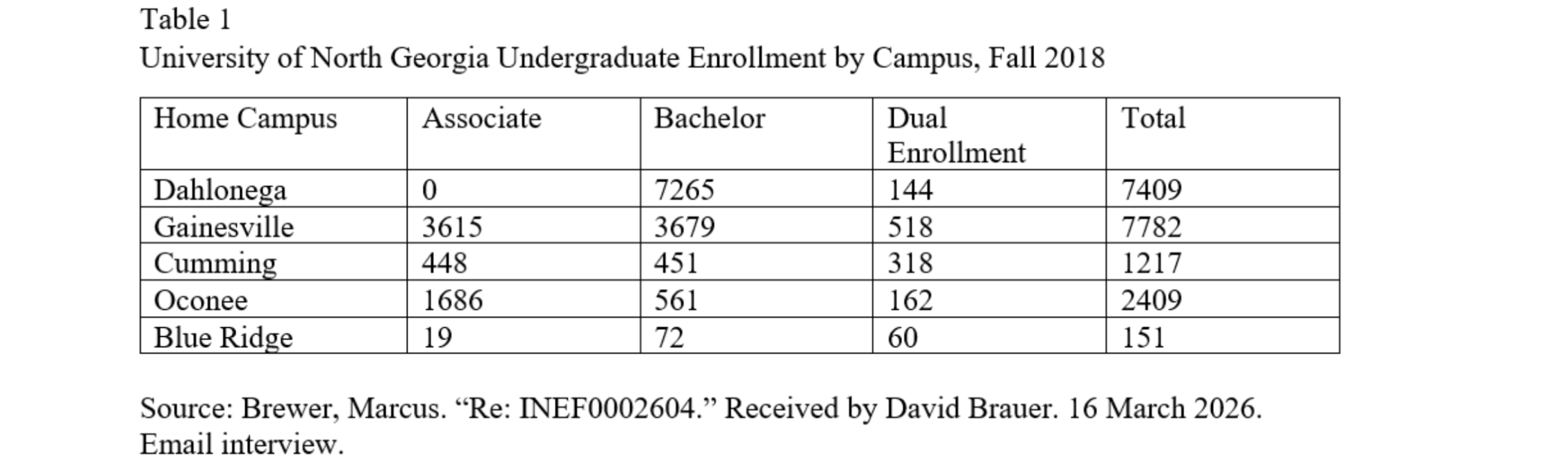
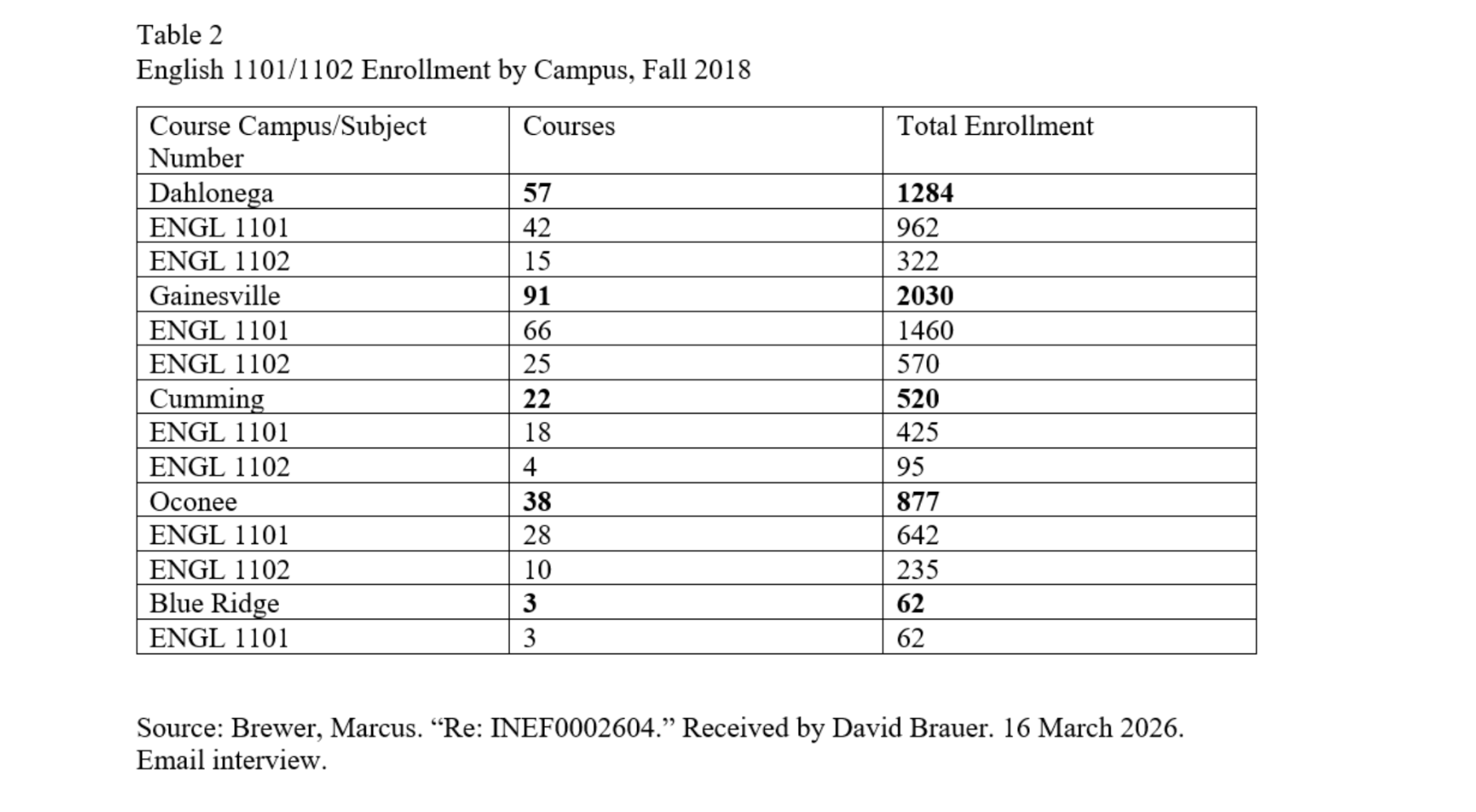
In 2012, the University of North Georgia was situated on a single campus. At that time, the writing center served fewer than 4,000 students. Since then, consolidations and mergers have created a multi-campus institution. The five main and four extended campuses have different entrance requirements and thus serve a diverse student population. The FYC writing program administrator (WPA) is required to navigate the differences between locations while attempting to provide a singular vision for FYC. To be clear, my university has an incongruous multi-campus identity—because some campuses emphasize A.A. programs over B.A. programs, not all students enter the university under the same entrance requirements. The implication is that when it comes to learning support, one size does not fit all, as each campus varies widely in the makeup of students seeking an associate’s or bachelor’s degree (see Table 1). Even so, the FYC program is uniform across the various campuses, though the campus-specific enrollment in those courses reflects the distinctions in enrollment and degree program (see Table 2).
In 2018, university administrators launched the Gateways to Completion (G2C) program, an initiative aimed at addressing high rates of failure or withdrawal (aka “DFW” rates) in core curriculum courses. Departments were responsible for making changes to their curriculum that would theoretically improve student retention.The FYC committee at my institution chose English 1101, the first course in the two-semester FYC sequence, as its focal point for reform. The committee developed numerous changes to the course, most of which were revisions to the course structure and instructor-based interventions (e.g. student conferences, iterative feedback on drafts). Suggestions included a scaffolding or portfolio assessment structure for major assignments and the use of peer review during the writing process. Such elements are designed to extend the writing process, thus improving the possibility of completing the assignment successfully. These interventions also make the course more manageable for the numerous contingent faculty members who teach it, since a lengthened period for writing assignments eases the grading load. Other interventions—including visits to the writing center—were provided in a list of “further options” for improving student learning. Nowhere in the planned revisions to the curriculum and to English 1101 did the writing center have a prominent role in improving student retention in the course. In fact, over the three-year period of planning and piloting the Gateways program for FYC, I was never directly consulted by the committee for input on the potential role of the writing center to help them achieve their goal.
Partly because the university’s writing center follows different models on different campuses, the FYC committee decided against giving the writing center a prominent role in their course re-design. Though the writing center would seem like a natural partner in such an endeavor, the differences in structure from campus to campus arguably make it less consistent as a student resource. The focus on process-oriented pedagogy would also seem to encourage student use of the writing center, but the committee instead placed emphasis on instructor intervention, peer review, and hybrid grading, all to create a centripetal system that emphasized the classroom and the instructor. Relative to the instructor and the students in any course that had to be changed, the writing center was largely overlooked in the committee’s action plan.
The structural change the University of North Georgia made to become a multi-campus environment mirrors changes to the core curriculum. As a result, prospects for collaboration between FYC and the writing center were undermined. The aspiration for student success and retention may have made English 1101 more efficient with a curricular design centered on protracted writing processes and frequent interventions by the instructor. Over time, however, the changes to the course had what I saw as a predictable impact: fewer FYC students on my campus attended writing center sessions, fewer instructors suggested or required writing center visits, and new instructors were shuttled into the G2C program without considering the value of writing center tutoring as a primary form of supplemental instruction for their students.
The actions taken by the institution and FYC committee reflect what Donna Strickland terms the “managerial” aspect of composition studies. Strickland defines the managerial as
a third term that usefully breaks up the usual dichotomies of teaching/research, marginal/central, and productivity/ consumption that have long circulated through the discourse of composition studies. (7)
Put simply, the FYC committee was given the directive to “manage” their curricula in order to improve retention and grade distribution; the FYC course grade distribution was a problem that needed to be solved. Given the constraints of a multi-campus setting, the FYC committee felt it had limited options. Perhaps they could have chosen a less managerial strategy, but that alternative strategy may not have met the requirements of the directive.
The institution-wide directive and the FYC’s decisions had a ripple effect, and the writing center had to adjust to the changed environment. I adopted a number of solutions that addressed both the material and the symbolic domains: I evaluated the Gateways training materials given to FYC faculty in order to understand what was stipulated in the initiative regarding course design, assignment design, and pedagogy; I communicated directly with faculty and administrators about how the writing center might support the increased emphasis on peer review in FYC; and I helped writing center staff adjust their tutoring practices to account for the changes that were now in effect. I also initiated a monthly discussion group with faculty teaching the English 1101/1102 sequence in which we conversed about FYC pedagogy and how to improve the lines of communication between contingent faculty and the writing center. These actions enabled the writing center to account for changes in practice and provided me avenues for shaping the symbolic domains associated with the initiative, FYC, and writing pedagogy. My solution was neither resignation towards nor rejection of material changes in the institution; rather, I adjusted to the changes in the material domain and negotiated the symbolic domain as an institutional agent. I had misgivings about the operational changes the Gateways initiative would make to the writing center, but I worked to ensure its viability in this new environment.
Though they can both be considered sponsors of literacy, the writing center and FYC diverge in operational ways and serve different roles in academia. But institutional logics can set these entities at odds with one another, and the identities formed as a result may exacerbate the divergence. Such tension is defined by institutional theorists as “differentiation,” a phenomenon that accounts for “the diversity of institutional logics enabling different forms of interaction and organizational practices in organizations and institutional domains leading to institutional complexity” (Thornton et al., 99). In my case, the WPA operated according to the requirements necessary to establish reproducible practices and promote more instructor-centered intervention toward positive outcomes for students in FYC. And though I too wanted positive outcomes for those students, I was interested more in fostering exploratory dialogue in the tutoring session and student-centered interventions. Directly speaking, course grades and retention matter less to the writing center staff than to both the FYC committee and writing instructors. [6]
When an institution’s practices or values fundamentally change, paths for agency will emerge. Richard Scott explains: “A more conflicted or ambiguous environment allows for strategic and agentic behavior” (473). In my circumstance, effective agency involved recognizing that hostility toward the Gateways initiative would prove fruitless. As the initiative reshaped existing institutional logics, I saw that my assumptions about the relationship between the writing center and the writing program disciplines needed to change. Instead of spurning the new methods, I engaged writing center tutors and fellow writing instructors in conversations about the consequences of the initiative on teaching and tutoring alike, in both formal and informal campus settings. I operated in these contexts as both the director of a writing center and as a department colleague to both reflect on pedagogical strategies and cast a vision for helping students develop their literacy skills. In direct and indirect ways, I made the case that student intervention occurs at multiple sites, and that at every step, institutional practice and institutional discourse are intertwined.
The diversity of student populations across our various campuses results in an FYC program that has no compelling rationale to connect itself to a single model of writing center work. [7] Thus, the FYC program has jettisoned any partnership with the writing center and other related tutoring service in the institution. This posture does not appear to have been a conscious choice; rather, it may be that the FYC program simply does not have the luxury of linking itself to a specific model of student learning support. If so, the relationship between FYC and the writing center can be defined only in part by the shared disciplinary backgrounds of the leadership of the WPA and the WCD: the institution may in fact serve as the primary arbiter for this relationship. Institutional and environmental forces collectively constitute what scholars have identified as institutional logics. The term institutional logics was first defined by Roger Friedland and Robert Alford as “a set of material practices and symbolic constructions” (Cai & Mehari, 6), a combination of social and discursive elements that provide an institution with its organizing principles.
A New Theoretical Frame for New Institutional Dynamics
To understand the role of institutional logics in writing center work, I have augmented writing center scholarship within the context of institutional theory. Institutional theory draws from multiple disciplines to interrogate the assumption that institutional context matters as much—or more—than the shared context of academic discipline. Institutional theory serves higher education by providing concepts and methods for understanding how universities and colleges work. Early theories of institutionalism focused largely on how organizations change; new institutionalism focused on how organizations gain stability and legitimacy. More recent strands (Scott) focus on how human agents shape institutional change (Cai & Mehari). [8] Institutional structure may feel passive, but it shapes participants’ lived experience. Richard Scott asserts that “Norms of rationality play a causal role in the creation of formal organization” (5). Organizations are made up of individuals, but the entity influences the thinking in their participants. Patricia Thornton et al. explain the dynamic: “The principles, practices, and symbols of each institutional order differentially shape how reasoning takes place and how rationality is perceived and experienced” (2). Though we bring disciplinary knowledge to an institutional setting, that setting can in turn reshape how we perceive ourselves and our roles as instructors, faculty, or administrators. The given assumptions or logics may be implicit, but not all institutional logics are experienced as coherent by its members. Richard Scott considers how institutions are shaped by “conflicting logics” (13). For example, an institution may appear uniform and efficient in its operations, but it may have agents and agentic forces with competing or divergent assumptions. But Scott explains the upside to this scenario: “A more conflicted or ambiguous environment allows for greater opportunity for strategic and agentic behavior” (13). For participants who understand their circumstances, chaos and conflict may lead to effective change. Divergent logics arguably provide fertile soil for enacted agency.
Recent institutional theory suggests institutional participants must recognize and inhabit the logic of the institution in order to operate within it effectively. Thornton et al. elaborated upon the work of Friedland and Alford to highlight the potential for both stasis and change within an institutional setting. Thornton et al. defined institutional logics as “the socially constructed, historical patterns of cultural symbols and material practices, including assumptions, values, and beliefs, by which individuals and organizations provide meaning to their daily activity, organize time and space, and reproduce their lives and experiences” (2). The ILP binary of the material and the symbolic allows researchers to unpack the various ingredients of institutional life and practice. While the material includes actions, daily activities, resources, physical space, and budgetary issues, the symbolic includes ideas, rhetorical situations and tactics, credentialing, disciplinary background and assumptions, and institutional beliefs and values. Institutional logics populate both realms, enabling us to recognize this binary and how these distinctions may overlap. Thornton and Ocasio added a third institutional realm, the normative, which encapsulates the reproducible or isomorphic elements of institutions. Though these realms may be defined separately, ILP “integrates the structural, normative, and symbolic as three necessary and complementary dimensions of institutions, rather than separable structural (coercive), normative, and symbolic (cognitive) carriers [of institutional logics]” (101). While we may separate these strands in order to analyze them, these strands may prove difficult to separate within the institutional domain.
The institutional logics perspective analyzes the dynamic relationships between the individual actor and the institution and between the material and the symbolic, highlighting how institutions develop a kind of rationality that legitimizes their values and practices and enables those within the institution to make sense of their experiences. Within the ILP, actors have “partial autonomy” (Thornton et al, p.7) and thus can have agency even while they are constrained by institutional forces. Institutional context, which is never neutral, provides exigencies and motives for its participants. These two elements comprise institutional attention, “by generating a set of values that order the legitimacy, importance, and relevance of issues and solutions; and…by providing decision makers with an understanding of their interests and identities” (114). Just as a rhetorical exigence is the seed of rhetorical practice, institutional attention is the seed of institutional agency. One product of institutional agency is the concept of institutional entrepreneurship. The institutional entrepreneur is defined by Cai and Mehari as those individuals who “not only initiate diverse changes in the institutional environment but also actively participate in the implementation of such changes” (5). Such individuals either have or develop agency sufficient for having a transformative impact on their institution. [9] While they are shaped and constrained by the institutional context, the institutional entrepreneur has the agentic capacity to reshape the institutional logics at work, and, by consequence, the institution itself.
When it comes to institutional agency, many WCDs operate within the realm of the pragmatic: we tend to believe that if we can develop the right alliances on campus and obtain our rightful piece of the budgetary pie, then “the rest” will take care of itself (see Simpson, White). But ILP portrays a more complex picture: “The term ideology aligns itself with the doctrine of materialism, whereas the institutional logics perspective emphasizes the interpenetration of the symbolic and material aspects of institutions” (Thornton et al., 5). The social context of the institution ensures that the material and the symbolic may be disambiguated from one another through analysis or reflection but are never truly separate in an institutional scene. Thornton et al. explain: “By material aspects of institutions, we refer to structures and practices; by symbolic aspects, we refer to ideation and meaning, recognizing that the symbolic and the material are intertwined and constitutive of one another” (10). We may conceptualize the relationship between the material and the symbolic as a kind of feedback loop in which change in one aspect leads to change in the other. For example, if a writing center occupies an out-of-the-way location on campus, that location may indicate a lower-priority status for student support on that campus. If the symbolic aspect within an institution has well-defined values and beliefs, then the material domain may prove difficult to change. That said, one interpretive scheme for understanding the material-symbolic relationship will not account for all contingencies. The WCD who focuses exclusively on material conditions may ignore the symbolic conditions that determine material conditions. While material conditions feel more tangible and therefore more important, it may be that the symbolic domain should command the attention of the WCD.
The intertwining of the material and the symbolic often manifests in broad initiatives, specifically those whose work concerns student performance and degree completion. The material impact on institutional practice requires specific academic departments and faculty to carry out an initiative by improving student experience and providing tools for students to complete courses successfully. This dynamic constitutes what Thornton et al. define as a “frame,” an amalgam of concrete and abstract information designed to “facilitate identification and mobilization, and therefore agency and institutional change” (152). In changing institutional practices, it sets forth directives and a time frame with a call for deliverables to administrators. Symbolically, it reflects institutional values such as accommodation, inclusivity, student-centeredness, and pedagogical hospitality. But the symbolic serves a material end, as the program is designed to ensure that more students continue and eventually complete their education, maximizing the tuition revenues for the university system. For the upper administration, the emphasis centers on material changes, but the initiative is articulated symbolically to provide a rationale for doing things differently. The goals for students are clear: retention and degree completion. According to the logic of the initiative, these outcomes constitute success. By consequence, the academic environment makes itself conducive to these material outcomes. The initiative and its influence on literacy sponsors exemplifies what Scott identifies as “conflicting logics” (Cai and Mehari 4). The long-term impact on the institution is conflicted: an initiative directed toward student learning and retention may apply more pressure to contingent faculty while underemphasizing resources such as the writing center—resources designed to alleviate pressure on faculty and improve student learning in writing courses.
The debate about pedagogical interventions for students involves both the material domain of classroom practice and the symbolic domain of institutional values and disciplinary assumptions that shape classroom practice. Though the WCD may want to lean on disciplinary training for a roadmap through such scenarios, it is the institution that enables the WCD to apply disciplinary knowledge in meaningful ways. Such applications are defined in ILP theory as bounded intentionality, the ways in which an individual is culturally embedded in a social group with which they identify, that affords them not only an identity to which they are emotionally committed…but a cognitive schema that focuses their attention on ‘particular features’ of organizations and their environments, conditions their goals and provides them a distinctive repertoire of practices presumed to attain them. (Friedland 591)
We may tend to think of the institution as supplying the material that runs parallel to the symbolic freight of our disciplinary understandings. But it is the interplay between the material and the symbolic that shows how institutional logics shape our daily lives and change the ways that we define and understand our institutional roles.
The ILP focus on institutional change also sheds light on the strengths and weaknesses of scholarly narratives about writing center work. Jackie McKinney asserts that writing center administrators often describe the work of the writing center according to a “grand narrative” associated with this domain (4). But while this narrative provides familiarity and comfort, its influence may prove deleterious. McKinney explains: “The story has focused our attention so narrowly that we already no longer see the range and variety of activities that make up writing center work or the potential ways in which writing center work can evolve” (5-6). The narrative of writing center work relies on a coherent definition of the place of tutoring in higher education. But the academy is always subject to change. As we attend to what Kris Fleckenstein calls “systems of perception” (10) that shape our work, ranging from institutional logics to disciplinary assumptions, we become more responsive to such changes. It may only be when the material and/or symbolic domains of an institution evolve that we recognize those domains and how they shape our understanding of and experience within the institution. As the ground shifts during seasons of change, contradictions between those institutional logics may reveal themselves. The crisis may prove sudden and acute (e.g. a mandated consolidation of several institutions with different educational missions) but may also reflect an emerging focus in higher education administration (e.g. the introduction of the retention initiative several years following the consolidation). Thornton et al. define this set of circumstances as “event sequencing”: “the temporal and sequential unfolding of unique events that dislocate, rearticulate, and transform the interpretation of cultural symbols’ and material practices’ meaning” (122). Any significant change at an institution in terms of its makeup and/or leadership may redefine the institutional logics that undergird its day-to-day practices and assumptions. The WCD can assess how shifts in the values and activities of an institution may affect how the writing center relates to other agents, especially those it would identify as traditional allies.
Michelle Miley asserts that WCDs should focus on “making sense of our work as it coordinates or collides with the work of others” (112). While relationships play a significant part in Miley’s point, “making sense” involves making meaning. Ironically, relationships may depend on the ways in which making meaning “coordinates” or “collides” with other institutional agents. One such “collision” may arise from divergent meanings of pedagogical intervention. At my institution, the institutional directive led system administrators and the FYC director to locate intervention within the classroom. Meanwhile, the writing center located intervention in the tutoring session. The dissonance in institutional logics resulted in material practices that applied disciplinary and pedagogical knowledge in contradictory ways. Ianetta et al. argue that “if the authority and expertise of the WCD draws on a body of knowledge distinct from that of the composition program director, pedagogical conflicts may emerge from the conflicting paradigms, hindering the efforts of writers and teachers in both settings” (12). Disciplinary camaraderie may be overcome by the pressures of institutional logics. If the WCD and the WPA occupy different positions within the institution, they may well speak different institutional languages. Roger Friedland explains that “[i]t is precisely in such situations, where rival vocabularies are at play and reference is contested, that will and force, identity as subjective commitment and power as compulsion are most likely to be important” (593). Institutional logics may undermine otherwise cooperative relationships among institutional actors and may turn disciplinary allies into institutional rivals.
ILP challenges conventional ways of thinking about agency within institutional settings. But while its novel approach to both institutional critique and institutional transformation makes ILP an attractive theory, it draws a contrast with the analyses pursued by composition scholars. These scholars have evaluated institutional dynamics through the lens of material working conditions and labor concerns. Strickland and Bousquet characterize the modern university as driven by efficiency and productivity. Such emergent values in higher education have created an environment that values neither student learning nor faculty labor. The aforementioned “managerial culture” which Strickland finds within modern universities prioritizes conformist practices over “disciplinary knowledge and scholarship” (9-10). For Strickland, even the positions of WPA and WCD indicate the managerial role of faculty in composition work. The creation of the WPA position represents “a conceptual and practical break between the work of studying writing and rhetoric in general and the work of directing writing programs” (85-86). Institutional forces thus break the bonds of disciplinary identity, as the priorities and values of writing programs and writing centers are surreptitiously undermined by the prevailing culture of American higher education.
Like Strickland, Bousquet places the blame on the managers: “Plainly put, higher education administration pervasively and self-consciously seeks control of the institution by seeking to retool the values, practices, and sense of institutional reality that comprise faculty and student culture” (l2). Institutional change may herald progressive impetuses, but it may also disclose administrative desire for control. But administrators are not the only problem. For Bousquet, the dirty little secret of higher education is “the compliance of the tenured with management’s development of a second tier of labor” (82). That second tier is, of course, contingent faculty and instructors, most of whom are tasked with courses in FYC. Bousquet connects this contrast in faculty workload directly to the development of composition studies as a visible and viable discipline in the academy. He explains that “the disciplinary identity of tenurable faculty in rhetoric and composition has emerged in close relation to the permatemping of the labor force for first-year writing” (158). While FYC has institutional value, most writing instructors lack rhetorical power or professional agency within institutional settings. The result is, as Bousquet explains, that composition studies has moved away from critical theory toward institutionally-focused pragmatism, toward acceptance of market logic, and toward increasing collaboration with a vocational and technical model of education. (161)
The composition faculty member has become a “pragmatic philosopher” (175) and the discipline has become a “management science” (168). Over time, this pattern undermines agency and fosters interpellation—the faculty member no longer acts but instead adapts to institutional expectations. If the rhetorical logic of an institution undoubtedly shapes the work of the WPA and the WCD, these faculty administrators may in turn neglect to respond to that logic with their own disciplinary motives and purposes.
Drawing Inferences, or: Where Do We Go from Here?
So how does the writing center maintain and/or develop agency in such a scenario? First, WCDs cannot forget the purpose of our work: to support the institutional mission. The WCD play their role within a given institution, thus exemplifying “partial autonomy” (Thornton et al., 7) or “embedded agency.” Thornton and Ocasio define “embedded agency” as being a balance between autonomy and restriction:
While individual and organizational actors may seek power, status, and economic advantage, the means and ends of their interests and agency are both enabled and constrained by prevailing institutional logics. (103)
The role of the WCD within an institution may limit certain options, but it is also a role that affords agency. The daily, in-person work required is not isolated from the symbolic position within the institution. For example, a research skills workshop for FYC students reflects an emphasis on discipline-specific writing. A task that may feel inconsequential to the WCD possesses symbolic implications for multiple agents and entities, not simply for the writing center or the WCD.
In applying ILP to the institutional agency of the WCD, I see two main strategies for maintaining and/or developing agency. One is passive, one is active. The first strategy employs what Thornton et al. call “sensemaking,” defined as “the process by which social actors turn circumstances into situations that are comprehended explicitly in words and that serve as springboards for action.” Sensemaking enables the institutional actor to recognize and articulate institutional logics, but “sensemaking is [also] a mechanism by which institutional logics are transformed” (96). They continue: “Sensemaking is not merely passive understanding but rather provides symbolic means by which the institutional actor may “resolve ambiguity in ways that enable activity to occur” (133). Institutional logics may remain tacit until a moment of crisis highlights ambiguities, inconsistencies, or competing logics. Sensemaking helps us to see institutional logics, perhaps for the first time, and to conceptualize how and why those logics might change. If an isomorphic or “business-as-usual” viewpoint may limit the prospects for agency (7), sensemaking allows for agency in both the symbolic and material domains of an institution.
The second strategy is to use what I suggest to be rhetorical entrepreneurship. For Thornton et al., rhetoric has meaning for the symbolic and the physical aspects of an institution. If sensemaking is primarily analytical, rhetoric in the institutional setting is more creative, more purposeful in its telos: to change institutional logics and institutional practices to achieve a goal. Thornton et al. connect cultural entrepreneurs with rhetoric to show how specific actors “manipulate cultural symbols to obtain resources and to change practices” (124). Rhetorical entrepreneurship is neither techne nor ideology:
We used [ILP] to comparatively illustrate how individuals switched categories that referenced different symbolic analogies, sources of legitimacy, and bases of norms, with implications for a change in practices; it was not simply a struggle over material resources. (Thornton et al., 124)
In the ILP framework, effective agency is not limited to counterhegemonic practices but depends upon seeing the two domains of the material and the symbolic as always interrelated.
Agency can be said to be borne of sensemaking, which in turn leads to rhetorical entrepreneurship. Thornton et al. point out that the institutional entrepreneur “garner[s] resources…by identifying contradictions” (177). Whether one uses the symbolic to address material conflicts or use the material to address symbolic conflicts, the WCD can use these hermeneutics to theorize their institution effectively. Given that the material domain (budgets, campus location, etc.) may be shaped by variables beyond the control of the WCD, they might instead focus on the symbolic domain as the avenue for institutional transformation. To do so means recognizing and interpreting prevailing institutional logics, then applying rhetorical strategies to reshape or transform those institutional logics. Perhaps such an approach will serve to maximize the institutional identity of the writing center and its role in supporting student learning. [10]
The writing center exists because the classroom is not the only place where students can learn about writing: it follows the lead of curricula, then responds to students’ needs accordingly. But writing center work is not primarily about efficiency; its impact on academic performance and retention are often subtle. Writing center tutoring operates within the constraints of a writing assignment but transcends the classroom context in order to draw the student writer into fundamental reflection on their literacy skills, including rhetorical awareness, strategy, and tactics. As FYC finds itself increasingly caught up with institutional pressures to rush students to graduation, the result may be a pedagogy measured by quantifiable criteria alone. The term “student success” provides a transparent example of conflicting institutional logics; though the term may be deployed by various administrators to justify their decisions, the term may not hold the same meaning across intra-institutional contexts. Even given a clear directive, the symbolic domains are in conflict, resulting in “divergent bases of valuation and critique” (Friedland, 87). Examining institutional contexts reveals that FYC and the writing center are stewards of rhetorical pedagogy that may follow different logics and values. The constant changes in institutional dynamics and structure ensure that the WCD can no longer rely on isomorphic assumptions about the relationships among academic sponsors of literacy. Echoing the concerns of Porter et al., the tendency to perceive a given institution as a straightforward instantiation of disciplinary practice may be common, but it is counterproductive to effective critique and prospects for change (618-19). [11] Bruce Speck distinguishes between what he calls the faculty perspective and the administrative perspective. For Speck, the former centers on “values of community and autonomy” that “foster a limited, self-serving perspective of the academy,” whereas one occupying the latter perspective “think[s] globally, to consider the entire needs of the organization” (218-19). Applying Speck’s binary to ILP, I believe that the WCD may occupy a position that blends both the faculty perspective and the administrative perspective.
Given the urgency of addressing workplace issues and material conditions, institutional critiques in composition studies have characterized the symbolic as a reflection of the material. But ILP reminds us that the material and the symbolic exist in a feedback loop—attending to one inevitably reveals the underappreciated significance of the other. In ILP, material conditions are part of the larger domains of practice and activity that constitute the institutional setting. By implication, critique operates as productive resistance that reflects deep situational awareness and rhetorical sophistication. While the WCD can move against hierarchical power structures and unjust material conditions when the opportunities arise, they can also shape institutional environments to augment the symbolic relevance (i.e. the institutional “meaning”) of writing center work for students, faculty, and administrators. Both the WCD and the WPA should strive to become what Thornton et al. term “cultural entrepreneurs,” agents who use “stories and rhetorical strategies to manipulate cultural symbols to obtain resources and to change practices” (124). Rhetorical skills may not transform material conditions immediately, but those skills may enable a WCD to negotiate and reshape institutional values. Moreover, the WCD can develop sensemaking abilities that allow them to recognize the subtle institutional machinations of control and efficiency as well as strategies for countering those forces.
With increasing bureaucratic complexity in higher education, institutional priorities may undermine shared disciplinary background, a background that may not guarantee shared priorities within the institution. If sponsors of literacy are placed at cross purposes to one another, how will they find common ground when the ground has shifted beneath their feet? Michelle Eodice calls for collaboration as a signature practice for WCDs, but extenuating circumstances may render such arrangements difficult if not impossible. As Michelle Miley and Doug Downs demonstrate in their own experience, any chance for effective collaboration begins with open communication (40-1). The WPA and the WCD can work together to find at least some common ground in their analysis of the institutional logics that shape their relationship. Based on shared values and vision and mutual agreement about their institutional context, these administrators have an opportunity to forge an alliance in what might appear to be a zero-sum game. While Eodice argues that the WCD “can and should demand collaboration and continue to work toward boundarylessness” (129), Miley and Downs focus on reciprocity as a critical variable in achieving effective collaboration. This concept assumes a non-hierarchical dynamic in these scenarios, an ideal that may reshape institutional dynamics.
If administrative hierarchies and academic programs do not enable the WPA and the WCD to foster collaboration, then the WPA and the WCD may look to both institutional structures and informal conversation as alternatives (Miley and Downs 40-3). In formal arrangements, the WPA and WCD may find opportunities to interact within institutional committees. Less formally, the WPA and the WCD may generate department-level discussions or forums to engage in open-ended dialogue about institutional writing culture and program mission and vision. Ultimately, these scenarios represent means of getting the WPA and the WCD in the same room with increased frequency and may set the stage for cooperation. In institutional settings that may impede a productive relationship between the WPA and the WCD, such tactics recalibrate those dynamics and use the institutional structure and environment to bridge the distance between these institutional agents. Where conflict or institutional estrangement exists, the rhetorical principle of kairos offers a pathway toward resolution. Powell and Takayoshi define kairos as a “theoretical lens for understanding discomfort and dissensus so that we can be more prepared for and responsive to…rhetorical situations” that offers “generative power for rhetoric through…conflict resolution, which leads to new knowledge” (416, emphasis added). The rhetorical responsiveness of kairos enables the WCD to form new bonds with the WPA and to create new solutions in response to institutional challenges.
For most of the modern era of writing center work, writing centers have accommodated the shifting foci and interests of the discipline. But such accommodation has obfuscated the unique locus of the writing center as an institutionally bound manifestation of disciplinary work. Even in the most amicable scenario, the institutional setting complicates the relationship between FYC and the writing center. In my institutional context, administrative directives resulted in a circumstance in which neither accommodation nor rejection was a viable solution to the problems that I faced. As Thornton et al. explain, structure always has a limiting effect on agency (7). My narrative offers a warning to the WPA and the WCD alike—the changing landscape of higher education all but ensures that the institutional environments will become more complex, not less. In that complexity, disciplinary allies may lose track of each other. Thus, it is critical for writing center scholarship to resist isomorphic myths about the relationship between a writing center and a writing program. What “should be” according to disciplinary assumptions may not always prove the case, as institutional logics will regulate value, meaning, and practice within a given context. Writing center scholarship has much to learn from institutional theory and ILP about how extra-disciplinary influences shape disciplinary praxis. While ILP does not provide formulaic answers to institutional dilemmas, it offers a framework for understanding how the WCD and the writing center may address institutional settings and institutional changes. As academic infrastructures develop retention initiatives and grow more complex through institutional consolidation and multi-campus institutional settings, leaning on traditional assumptions may no longer prove viable. In an era of change in higher education, writing centers and writing center directors must be prepared to evolve and, when necessary, exchange old paradigms for new ones.
Endnotes
Lori Salem notes that empirical data indicates that “writing centers are the single most common model for academic support, and a majority of institutions have them” (37).
In evaluating the justification for a writing center within academic settings, Lori Salem points out that the reasons for opening a writing center followed a familiar model, as “whatever the individual motivations were, the decision to open a writing center suggests that factors outside the institution were at work, since the idea of a writing center comes from other institutions in the first place.” (23, emphasis Salem).
Balester and McDonald gathered data from a variety of institutional settings highlighting the mutual benefits of collaboration between a WPA and a WCD but also noting that a difficult or strained relationship between the WPA and the WCD was generally caused by lack of communication, lack of collaboration, or both.
Despite cooperation, writing center scholarship has fostered an identity as anti-hegemonic, iconoclastic, and proudly marginalized. Beginning with North’s “Idea” and carried on in Riley’s “The Unpromising Future,’ Grimm’s Good Intentions, and McKinney’s Peripheral Visions, the idea that the writing center would challenge institutional practices is well-established. Gardner & Ramsey label this perspective “anti-curriculum” (27).
Some readers may infer that the narrative portions of my essay recount a disciplinary or departmental conflict. This is not the case. Any tensions in my department arose from exogenous factors, specifically decision makers in the university system.
The FYC data for the 2019 academic year indicates that more than 70% of students in FYC courses earned a grade of A or B.
Amy Ward Martin explains how a multi-campus environment impacts multiple writing centers on those campuses: “These multiple centers technically exist at the same university and share the same mission, but the characteristics of each campus and the physical placement of each center may shape those centers in ways that may make sense for one campus but not for the other[s]” (127).
For a brief overview of institutional theory, see Yuzhuo Cai & Yohannes Mehari.
Thornton et al. summarize Richard Scott’s theory of agency as follows: “Scott defines agency as an actor’s ability to have some effect on the social world—altering the rules, relational ties, or distribution of resources” (6-7). As both Scott and Thornton explain, agency has impact on both material and symbolic domains.
Porter et al. define institutional critique as follows: “Institutional critique examines institutions as rhetorical designs…in order to expose and interrogate possibilities for institutional change through the practice of rhetoric” (631). Institutional spaces are thus both “material and discursive” (620).
Porter et al. explain this point further: “The simple equation, discipline=institution, blocks consideration of material, economic, and organizational factors that are key to changing institutions. We argue that equating institution with discipline denies important physical dimensions and limits the potential for productive action” (619).
Works Cited
Balester, Valerie, and James C. McDonald. “A View of Status and Working Conditions: Relations Between Writing Program and Writing Center Directors.” WPA Journal, vol. 24, no. 3, 2002, pp. 59–82.
Brewer, Marcus. “Re: INEF0002604.” Received by David Brauer. 16 March 2026. Email interview.
Boquet, Elizabeth. “’Our Little Secret’”: A History of Writing Centers, Pre- to Post-Open Admissions.” The Allyn and Bacon Guide to Writing Center Theory and Practice. Edited by Robert W. Barnett and Jacob S. Blumner. Allyn and Bacon, 2001, pp. 41–60.
Bousquet, Marc. How the University Works: Higher Education and the Low-Wage Nation. New York UP, 2008.
Cai, Yuzhuo, and Yohannes Mehari. “The Use of Institutional Theory in Higher Education Research.” Theory and Method in Higher Education Research. Edited by Jeroen Huisman and Malcolm Tight. Emerald Group Publishing, 2015, pp. 1–26.
Carino, Peter. “Early Writing Centers: Toward a History.” The Allyn and Bacon Guide to
Writing Center Theory and Practice. Edited by Robert W. Barnett and Jacob S. Blumner. Allyn and Bacon, 2001, pp. 10–21.
Eodice, Michele. “Breathing Lessons or Collaboration Is…” The Center Will Hold: Critical Perspectives on Writing Center Scholarship. Edited by Michael A. Pemberton and Joyce Kinkead. Utah State UP, 2003, pp. 114–29.
Fleckenstein, Kristen. Vision, Rhetoric, and Social Action in the Composition Classroom.
Southern Illinois UP, 2010.
Friedland, Roger. “The Institutional Logics Perspective: A New Approach to Culture, Structure, and Process.” M@n@gement, vol. 15, no. 5, 2012, pp. 582–95.
Gardner, Phillip J. and William M. Ramsey. “The Polyvalent Mission of Writing Centers.”
The Writing Center Journal, vol. 25, no. 1, 2005, pp. 25–42.
Grimm, Nancy. Good Intentions: Writing Center Work for Postmodern Times. Heinemann, 1999.
Haviland, Carol Peterson, et al. “The Politics of Administrative and Physical Location.” The Politics of Writing Centers. Edited by Jane Nelson and Cathy Evertz. Boynton/Cook, 2001, pp. 85–98.
Ianetta, Melissa, et al. “Polylog: Are Writing Center Directors Writing Program
Administrators?” Composition Studies, vol. 34, no. 2, 2006, pp. 11–42.
Isaacs, Emily, and Melinda Knight. “A Bird’s Eye View of Writing Centers: Infrastructure,
Scope, and Programmatic Issues, Reported Practices.” WPA: Writing Program Administration, vol. 37, no. 1, pp. 36–67.
Lerner, Neal. “What is the Writing Center?” A Rhetoric for Writing Program Administrators (2nd ed). Edited by Rita Malenczyk. Parlor Press, 2016, pp. 271–83.
Martin, Amy Ward. “The Center Has Two Faces: Developing a Writing Center in a Multicampus University Setting.” The Writing Center Director’s Resource Book. Edited by Christina Murphy and Byron L. Stay. Routledge, 2010, pp. 127–34.
McKinney, Jackie Grutsch. Peripheral Visions for Writing Centers. Utah State UP, 2013.
Miley, Michelle. “Looking Up: Mapping Writing Center Work Through Institutional
Ethnography.” The Writing Center Journal, vol. 36, no. 1, 2017, pp. 103–29.
Miley, Michelle, and Doug Downs. “Crafting Collaboricity: Harmonizing the Force Fields of Writing Program and Writing Center Work.” Writing Program and Writing Center Collaborations: Transcending Boundaries. Edited by Alice Johnston Myatt and Lynee Lewis Gaillet. Palgrave MacMillan, 2017, pp. 25–46.
North, Stephen. “The Idea of a Writing Center.” The Allyn and Bacon Guide to Writing Center Theory and Practice, edited by Robert W. Barnett and Jacob S. Blumner. Allyn and
Bacon, 2001, pp. 63–78.
Porter, James E., et al. “Institutional Critique: A Rhetorical Methodology for Change.” College Composition and Communication, vol. 51, no. 4, 2000, pp. 610–41.
Powell, Katrina M., and Pamela Takayoshi. “Accepting the Roles Created for Us: The Ethics of Reciprocity.” College Composition and Communication, vol 54, no. 3, 2003, pp. 394–422.
Riley, Terrance. “The Unpromising Future of Writing Centers.” The Writing Center Journal, vol. 15, no. 1, 1994, pp. 20–33.
Salem, Lori. “Opportunity and Transformation: How Writing Centers are Positioned in the Political Landscape of Higher Education in the United States. The Writing Center Journal, vol. 34, no. 1, 2014, pp. 15–43.
Scott, Richard. “Institutional Theory: Contributing to a Theoretical Research Program.” Great Minds in Management: The Process of Theory Development. Edited by Ken G. Smith and Michael A. Hitt, Oxford UP, 2007, pp. 460–85.
Simpson, Jeanne. “Perceptions, Realities, and Possibilities: Central Administration and Writing Centers.” The Allyn and Bacon Guide to Writing Center Theory and Practice. Edited by Robert W. Barnett and Jacob S. Blumner. Allyn and Bacon, 2001, pp. 189–93.
Speck, Bruce W. “Managing Up: Philosophical and Financial Perspectives for Administrative
Success.” The Writing Center Director’s Resource Book. Edited by Christina
Murphy and Byron L. Stay. Routledge, 2010, pp. 215–24.
Strickland, Donna. The Managerial Unconscious in the History of Composition Studies.
Southern Illinois UP, 2011.
Thornton, Patricia, and William Ocasio. “Institutional Logics.” The Sage Handbook of Organizational Institutionalism. Edited by Royston Greenwood et al. Sage Publications, 2008, pp. 99–129.
Thornton, Patricia, et al. The Institutional Logics Perspective: A New Approach to Culture,
Structure, and Process. Oxford UP, 2012.
Waldo, Mark L. “What Should the Relationship between the Writing Center and Writing
Program Be?” The Allyn and Bacon Guide to Writing Center Theory and Practice. Edited
by Robert W. Barnett and Jacob S. Blumner. Allyn and Bacon, 2001, pp. 168–75.
White, Ronald V. “Managing Innovation.” ELT Journal, vol. 41, no. 3, 1987, pp. 211–18.