Praxis: A Writing Center Journal • Vol. 23, No. 3 (2026)
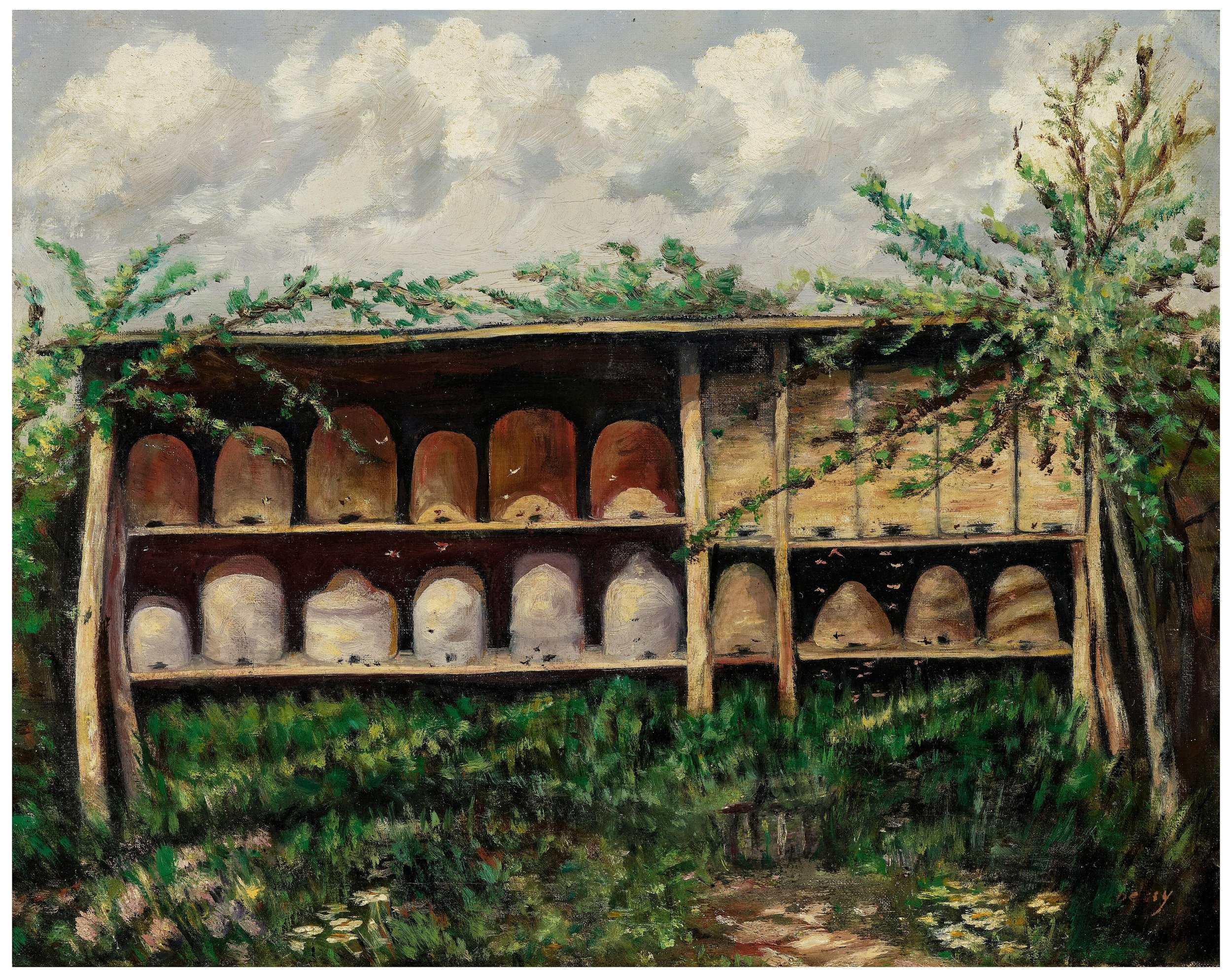
Image: Tölgyessy, Artúr. Beehives. Before 1920, Dorotheum. Wikimedia Commons.
The “Beehive Effect”: Rethinking Space, Observation and Pedagogy in Writing Centres
Joel Benabu
University of Toronto, Mississauga
j.benabu@utoronto.ca
In September 2019, my colleagues and I toured the newly completed space that would soon house the Robert Gillespie Academic Skills Centre at the University of Toronto, Mississauga. The space was not yet fully inhabited; ladders, toolboxes, and extension cords were still visible throughout. After the tour, the Centre’s director led each instructor, one at a time, to a private office that would serve as a one-on-one tutoring space, designed to minimize distraction and support focused work with students. My new office was calm and uncluttered, yet its silence felt almost sealed off from the world. This stillness stood in sharp contrast to the dynamic, communal space I had left behind months earlier.
Before this relocation, the writing centre had for many years been housed on the third floor of the University of Toronto’s Mississauga Library, which provided a more convivial setting. That older site carried its own distinctive soundtrack: the sharp ring of frantic telephone calls, the mechanical whir of photocopiers, and the muffled shuffle of feet against threadbare carpeting. Its narrow corridors were always abuzz with writing centre instructors and staff moving at a frantic pace, all humming as they attended to students’ needs. Students spanning undergraduate and graduate study would gather at one end of the corridor outside the main office, forming a line that sometimes zigzagged beyond the centre itself and into the library, everyone hoping to claim a brief window of access: to meet with a writing instructor, to book an appointment, or to secure a last-minute cancellation.
In this original location, one-on-one consultations took place in a small, designated area of approximately 500 square feet that had been shaped as much by necessity as by design. What lingers in memory are fragments: a small modular chamber of outfitted with four desks and a few mismatched chairs; a physical bulletin board covered with program flyers; cabinets holding shared instructional materials; and, eventually, whiteboards stocked with dry erase markers. During peak hours here, as many as five one-on-one consultations unfolded concurrently.
At first glance, this environment might appear ill-suited to productive labour, even counterproductive. In practice, however, it gave rise to a distinctly cooperative and formative mode of instructional work. Within its close quarters, instructors were consistently attentive to one another, often checking in after sessions to ensure they had not disrupted a colleague’s work. Voices lowered instinctively. Pacing shifted. Small adjustments were made in response to what was happening nearby. Far from producing disorder, the shared space fostered a strong sense of collective responsibility. There was an implicit understanding that individual consultations were in some ways interconnected and that the success of one depended, in part, on the care and awareness of all.
This interconnectedness moved beyond collegial courtesy, becoming an informal yet powerful site for learning about writing consultation practice. During appointment cancellations or late arrivals, I often listened in on nearby consultations, noticing how more experienced instructors framed questions, redirected conversations, or responded to student resistance. Through repeated exposure, I came to notice a practice used by a senior instructor who, early in a session, would pause after reviewing part of a draft and ask a simple but revealing question to the student: “What did you hope to communicate in this text?” The question gently illuminated the gap between the student’s intentions and execution, while also revealing how fully those ideas had been considered at the time of the appointment. After observing my colleague implement this instructional strategy repeatedly, each time with subtle variation and nuance, I began to experiment with using it myself. Much of what I learned from her emerged gradually, through a process of pedagogical incubation that relied less on commentary or formal reflection than on time, proximity, and a shared communal environment in which practice could take root.
Within the shared space, it also became possible to observe how instructors navigated more difficult moments. I recall a tense incident in which a student became confrontational with a younger, inexperienced instructor, raising his voice and dismissing her feedback. As the exchange escalated, nearby instructors paused their sessions and swarmed toward the disturbance, their response swift and coordinated. While some escorted the student to the main office, others remained with the instructor to provide comfort and support. Because consultations unfolded in close proximity, the situation was addressed quickly, documented clearly, and resolved decisively. The response required no announcement or directive; it emerged naturally from shared presence and awareness.
Seen in this light, such moments begin to resemble the dynamics of a beehive. As a working colony, a beehive is not organized around centralized command, but around proximity, responsiveness, and shared labour. Individual bees perform distinct roles within a common space, continually adjusting their actions in response to pheromonal cues, movement, and the immediate needs of the colony; coordination emerges instead through constant interaction, embodied signals, and collective sensitivity to the hive’s conditions.
Setting the biological analogy aside, this same underlying structure helps to illuminate the operation of writing centre spaces like the one I have been describing. Here, consultations are formally one-on-one yet spatially and socially interconnected. Within this space, instructors work side by side, remaining attuned to one another even while focused on their own sessions. Observation occurs incidentally and continuously, through peripheral listening, brief glances, and moments of shared attention. Learning is not transmitted top-down, as it often can be in formal director-to-instructor observation (Lawson 2), nor is it confined to scheduled exchanges of feedback as in the more egalitarian director-led peer-to-peer observation (e.g., Hall 2017; Kelly et al. 2022; Van Slembrouck 2010); instead, it develops gradually through immersion in a shared instructional ecology.
Traces of what I am calling the “beehive effect” persist, albeit in attenuated form, within the RGASC. One such instance is the Centre’s Writing Studio initiative, which meets daily for an hour and creates a shared, collaborative environment in which this dynamic can still emerge. In this space, several writing instructors work alongside one another, offering informal feedback to students who drop in without an appointment to write, reflect, and discuss their work. Within this setting, pedagogical practices that are often tacit become visible and accessible through ongoing, informal exchange. In this sense, the initiative stands as a modest reminder of what shared spaces can still sustain. At the same time, its position as the only remaining space of its kind at the RGASC lends greater force to a broader impression: that environments designed for collective presence, visibility, and pedagogical attunement have become increasingly scarce.
The concern animating this reflection is that the institutional infrastructure supporting such modes of tacit and processual learning for writing instructors has gradually contracted at the RGASC. This contraction may be attributed, in part, to the institutional pressures and shifting conditions to which writing centres must continually respond, including changing student needs and preferences, and unforeseeable disruptions such as those experienced during the COVID-19 pandemic. In responding to these pressures, changes to one-on-one consultation practices, whether the move to private offices or to online delivery, are often framed as technical or operational adjustments. Yet these adjustments carry pedagogical consequences, reshaping the subtle ecology through which instructors hone their craft and altering patterns of proximity, observation, and informal learning that often go unnoticed.
To be clear, these changes are not usually caused by a lack of physical space for multiple consultations. Instead, they tend to result either from external pressures such as public health measures that require isolation, or from institutional priorities that place student needs and preferences first. Many students prefer private spaces where they can speak openly with an instructor, and research suggests that some, especially those with attention or learning differences, are more easily distracted in noisier environments (Sahmurova and Gursesli, 2020). For these reasons, institutions may reasonably favor private consultation spaces over shared ones. However, even when these decisions are well justified, they still reshape the professional learning environment for writing instructors.
Seen in this light, a pressing question comes into focus: have writing centres come to place too much faith in formalized structures of observation (e.g. director-to-instructor observation), and too little in the quiet, generative labour that shared spaces already sustain? Stripped of metaphor, the question resolves more clearly: space in the writing centre is not merely a logistical arrangement or procedural convenience, but a constitutive condition of pedagogy itself, shaping the circulation of knowledge, the formation of practice, and the collective making of meaning.
* * *
This reflection offers a call to attention that may resonate beyond the confines of a single writing centre in Toronto, Canada. If the so-called “beehive effect” has disappeared or is in danger of disappearing from your writing centre as shared spaces are dismantled, it is worth asking where it might still be recovered, even in smaller or partial forms, as the RGASC has done through its Writing Studio initiative. Otherwise, what stands to be lost is not merely a room and its occupants, but a form of collective professional practice. For this reason, the “beehive effect” should not be dismissed as inconsequential or reduced to a relic of pre-pandemic times. Rather, it is better understood as a pedagogical resource whose value emerges in the everyday rhythms of communal work, in the low hum of a space where instructors are, quite literally, busy at work.
Works Cited
Hall, R. Mark. Around the Texts of Writing Center Work: An Inquiry-Based Approach to Tutor Education. Utah State UP, 2017.
Kelly, Megan, et al. “Notice, Ask, Explore: Transforming Peer Observation into Dialogic Reflection.” WLN: A Journal of Writing Center Scholarship, vol. 47, no. 2, 2022, pp. 41–58.
Lawson, Daniel. “Peer Observation, Reflection, and Evaluation Practices in the Writing Center: A Genre Pedagogy Approach.” Praxis: A Writing Center Journal, vol. 15, no. 2, Spring 2018, pp. 42–54.
Sahmurova, Aida, and Mustafa Can Gursesli. “Effects of Noise Pollution on Anger and Smoking Addiction in College Students.” IIOAB Journal, vol. 11, no. 5, 2020, pp. 42–47.
Slembrouck, Jane Van. “Watch and Learn: Peer Evaluation and Tutoring Pedagogy.” Praxis: A Writing Center Journal, vol. 8, no. 1, 2010, pp. 1–6.